Advertisements
Advertisements
Question
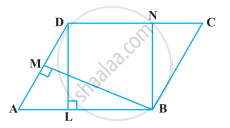
In the following figure, the area of parallelogram ABCD is ______.
Options
AB × BM
BC × BN
DC × DL
AD × DL
Advertisements
Solution
In the following figure, the area of parallelogram ABCD is DC × DL.
Explanation:
We know that, area of parallelogram is the product of its any side and the corresponding altitude (or height).
Here, when AB is base, then height is DL.
Area of parallelogram = AB × DL and when AD is base, then height is BM.
Area of parallelogram = AD × BM When DC is base, then height is DL.
Area of parallelogram = DC × DL and when BC is base, then height is not given.
RELATED QUESTIONS
Let ABCD be a parallelogram of area 124 cm2. If E and F are the mid-points of sides AB and
CD respectively, then find the area of parallelogram AEFD.
If P is any point in the interior of a parallelogram ABCD, then prove that area of the
triangle APB is less than half the area of parallelogram.
ABC is a triangle in which D is the mid-point of BC. E and F are mid-points of DC and AErespectively. IF area of ΔABC is 16 cm2, find the area of ΔDEF.
Medians of ΔABC intersect at G. If ar (ΔABC) = 27 cm2, then ar (ΔBGC) =
A floor is 40 m long and 15 m broad. It is covered with tiles, each measuring 60 cm by 50 cm. Find the number of tiles required to cover the floor.
Find the area of a rectangle whose length = 15 cm breadth = 6.4 cm
Which has the smaller area - two five-rupee notes together or a hundred rupee notes?
Measure the length of the floor of your classroom in meters. Also, measure the width.
- What is the area of the floor of your classroom in square metres?
Nasreena is a farmer who wants to divide her land equally among her three children — Chumki, Jhumri, and Imran. She wants to divide the land so that each piece of land has one tree. Her land looks like this.

- Can you divide the land equally? Show how you will divide it. Remember each person has to get a tree. Colour each person’s piece of land differently.
Find the area of the following figure by counting squares: