Advertisements
Advertisements
Question
Medians of ΔABC intersect at G. If ar (ΔABC) = 27 cm2, then ar (ΔBGC) =
Options
6 cm2
9 cm2
12 cm2
18 cm2
Advertisements
Solution
Given: (1) Median of ΔABC meet at G.
(2) Area of ΔABC = 27 cm2
To find: Area of ΔBCG.
We know that the medians of the triangle divides each other in the ratio of 2:1
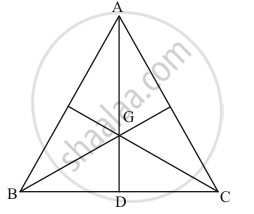
Hence,
ar (ΔBED) = `1/2 xx BC xx GD`
ar (ΔBED) =`1/2 xx BC xx 1/3 (AD)`
ar (ΔBED) =`1/3(1/2xx AD xx BC)`
ar (ΔBED) =`1/3 (Δ ABC)`
ar (ΔBED) = = `1/3(27)`
ar (ΔBED) == 9 cm2
APPEARS IN
RELATED QUESTIONS
ABCD is a parallelogram in which BC is produced to E such that CE = BC. AE intersects
CD at F.
(i) Prove that ar (ΔADF) = ar (ΔECF)
(ii) If the area of ΔDFB = 3 cm2, find the area of ||gm ABCD.
ABCD is a parallelogram whose diagonals AC and BD intersect at O. A line through O
intersects AB at P and DC at Q. Prove that ar (Δ POA) = ar (Δ QOC).
ABC is a triangle in which D is the mid-point of BC. E and F are mid-points of DC and AErespectively. IF area of ΔABC is 16 cm2, find the area of ΔDEF.
In a ΔABC if D and E are mid-points of BC and AD respectively such that ar (ΔAEC) = 4cm2, then ar (ΔBEC) =
Find the area of a rectangle whose length = 15 cm breadth = 6.4 cm
What is the area of the rectangle? ________ square cm
The King was very happy with carpenters Cheggu and Anar. They had made a very big and beautiful bed for him. So as gifts the king wanted to give some land to Cheggu, and some gold to Anar. Cheggu was happy. He took 100 meters of wire and tried to make different rectangles.
He made a 10 m × 40 m rectangle. Its area was 400 square meters. So he next made a 30 m × 20 m rectangle.
- What other rectangles can he make with 100 meters of wire? Discuss which of these rectangles will have the biggest area.
Each line gives a story. You have to choose the question which makes the best story problem. The first one is already marked.
- The cost of one book is Rs 47. Sonu buys 23 books.
a) How much money does she have? b) How much money does she pay for the books? c) What is the cost of 47 books?
Find the area of the following figure by counting squares:

Find the area of the following figure by counting squares:

