Advertisements
Advertisements
प्रश्न
Medians of ΔABC intersect at G. If ar (ΔABC) = 27 cm2, then ar (ΔBGC) =
पर्याय
6 cm2
9 cm2
12 cm2
18 cm2
Advertisements
उत्तर
Given: (1) Median of ΔABC meet at G.
(2) Area of ΔABC = 27 cm2
To find: Area of ΔBCG.
We know that the medians of the triangle divides each other in the ratio of 2:1
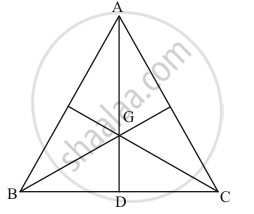
Hence,
ar (ΔBED) = `1/2 xx BC xx GD`
ar (ΔBED) =`1/2 xx BC xx 1/3 (AD)`
ar (ΔBED) =`1/3(1/2xx AD xx BC)`
ar (ΔBED) =`1/3 (Δ ABC)`
ar (ΔBED) = = `1/3(27)`
ar (ΔBED) == 9 cm2
APPEARS IN
संबंधित प्रश्न
ABCD is a trapezium with parallel sides AB =a and DC = b. If E and F are mid-points of non-parallel sides AD and BC respectively, then the ratio of areas of quadrilaterals ABFEand EFCD is
The diagonal of a rectangular board is 1 m and its length is 96 cm. Find the area of the board.
Find the area of a rectangle whose length = 15 cm breadth = 6.4 cm
Find the area of a square, whose side is: 4.1 cm.
What will happen to the area of a rectangle, if its length and breadth both are trebled?
Is the area of your belt the same as the area of the postcard? Why or why not?
Find all the possible dimensions (in natural numbers) of a rectangle with a perimeter 36 cm and find their areas.
Is the area of both your footprints the same?
Find the area of the following figure by counting squares:

Which statement correctly describes how area is determined?
