Advertisements
Advertisements
प्रश्न
Medians of ΔABC intersect at G. If ar (ΔABC) = 27 cm2, then ar (ΔBGC) =
विकल्प
6 cm2
9 cm2
12 cm2
18 cm2
Advertisements
उत्तर
Given: (1) Median of ΔABC meet at G.
(2) Area of ΔABC = 27 cm2
To find: Area of ΔBCG.
We know that the medians of the triangle divides each other in the ratio of 2:1
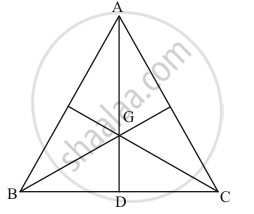
Hence,
ar (ΔBED) = `1/2 xx BC xx GD`
ar (ΔBED) =`1/2 xx BC xx 1/3 (AD)`
ar (ΔBED) =`1/3(1/2xx AD xx BC)`
ar (ΔBED) =`1/3 (Δ ABC)`
ar (ΔBED) = = `1/3(27)`
ar (ΔBED) == 9 cm2
APPEARS IN
संबंधित प्रश्न
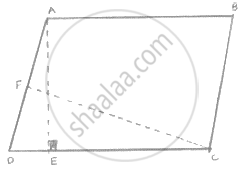
In fig below, ABCD is a parallelogram, AE ⊥ DC and CF ⊥ AD. If AB = 16 cm, AE = 8
cm and CF = 10 cm, find AD.
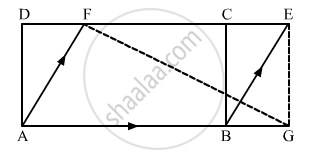
In the given figure, ABCD is a rectangle with sides AB = 10 cm and AD = 5 cm. Find the area of ΔEFG.
Each side of a square is 7 m. If its each side be increased by 3 m, what will be the increase in its area.
The side of a square field is 16 m. What will be increase in its area, if each of its sides is doubled?
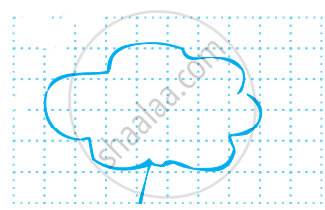
By counting squares, estimate the area of the figure.
The table given below contains some measures of the rectangle. Find the unknown values.
| Length | Breadth | Perimeter | Area |
| 13 cm | ? | 54 cm | ? |
Altogether how many squares can be arranged on it?
What is the area of the rectangle? ________ square cm
Nasreena is a farmer who wants to divide her land equally among her three children — Chumki, Jhumri, and Imran. She wants to divide the land so that each piece of land has one tree. Her land looks like this.

- Can you divide the land equally? Show how you will divide it. Remember each person has to get a tree. Colour each person’s piece of land differently.
Find the area of the following figure by counting squares:

