Advertisements
Advertisements
प्रश्न
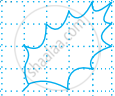
Find the area of the following figure by counting squares:
Advertisements
उत्तर
From the given figure, we observe
| Covered Area | Number | Area estimate (square units) |
| Fully filled squares | 2 | 2 |
| Half filled squares | – | – |
| More than half-filled squares | 6 | 6 |
| Less than half-filled squares | 6 | 0 |
Therefore total area = 2 + 6 = 8 square units.
संबंधित प्रश्न
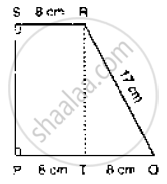
Compute the area of trapezium PQRS is Fig. below.
If AD is a median of a triangle ABC, then prove that triangles ADB and ADC are equal in
area. If G is the mid-point of median AD, prove that ar (Δ BGC) = 2 ar (Δ AGC).
A point D is taken on the side BC of a ΔABC such that BD = 2DC. Prove that ar(Δ ABD) =
2ar (ΔADC).
A, B, C, D are mid-points of sides of parallelogram PQRS. If ar (PQRS) = 36 cm2, then ar (ABCD) =
A floor is 40 m long and 15 m broad. It is covered with tiles, each measuring 60 cm by 50 cm. Find the number of tiles required to cover the floor.
Parth and Gini bought aam papad (dried mango slice) from a shop. Their pieces looked like these. Both could not make out whose piece was bigger.
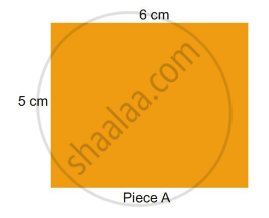

- Suggest some ways to find out whose piece is bigger. Discuss
Each line gives a story. You have to choose the question which makes the best story problem. The first one is already marked.
- A shopkeeper has 50 boxes. There are 48 fruits in one box.
Tick the one question which matches with the given problem.
Explain why (a) and (c) are not good choices.a) How much will the shopkeeper pay in all? b) How many fruits are there in all? ✓ c) How many more boxes will he need?
Whose footprint is larger - yours or your friend’s?
Find the area of the following figure by counting squares:
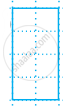
When using a square centimeter sheet for measurement, the area of one entire square equals:
