Advertisements
Advertisements
प्रश्न
In Q. No 1, if AD = 6 cm, CF = 10 cm, and AE = 8cm, find AB.
Advertisements
उत्तर
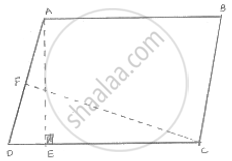
We know that,
Area of parallelogram ABCD = AD × CF ……(1)
Again area of parallelogram ABCD = DC × AE ……(2)
Compare equation (1) and equation (2)
AD × CF = DC × AE
⇒ 6 × 10 = D × B
⇒ ` D = 60 /8 = 7. 5cm`
∴ AB = DC = 7 . 5cm [ ∴ Opposite sides of a parallelogram are equal ]
APPEARS IN
संबंधित प्रश्न
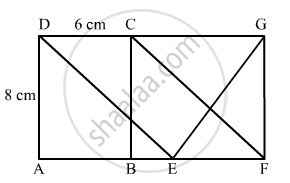
In the given figure, ABCD is a rectangle in which CD = 6 cm, AD = 8 cm. Find the area of parallelogram CDEF.
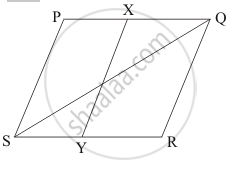
In the given figure, PQRS is a parallelogram. If X and Y are mid-points of PQ and SRrespectively and diagonal Q is joined. The ratio ar (||gm XQRY) : ar (ΔQSR) =
ABCD is a trapezium with parallel sides AB =a and DC = b. If E and F are mid-points of non-parallel sides AD and BC respectively, then the ratio of areas of quadrilaterals ABFEand EFCD is
The perimeter of a triangle ABC is 37 cm and the ratio between the lengths of its altitudes be 6: 5: 4. Find the lengths of its sides.
Let the sides be x cm, y cm, and (37 - x - y) cm. Also, let the lengths of altitudes be 6a cm, 5a cm, and 4a cm.
The diagonal of a rectangular board is 1 m and its length is 96 cm. Find the area of the board.
Find the area of a square, whose side is: 7.2 cm.
The side of a square is 3.6 cm; find its area.
What will happen to the area of a rectangle, if its length and breadth both are trebled?
Measure the length of the floor of your classroom in meters. Also, measure the width.
- So how many children can sit in one square meter?
Find the area of the following figure by counting squares:

