Advertisements
Advertisements
प्रश्न
A, B, C, D are mid-points of sides of parallelogram PQRS. If ar (PQRS) = 36 cm2, then ar (ABCD) =
विकल्प
24 cm2
18cm2
30 cm2
36 cm2
Advertisements
उत्तर
Given:
(1) PQRS is a parallelogram.
(2) A, B, C, D are the midpoints of the adjacent sides of Parallelogram PQRS.
(3) `ar ("||"^(gm) PQRS) = 36 cm^2`
To find: `AR("||"^(gm) ABCD)`
Calculation:
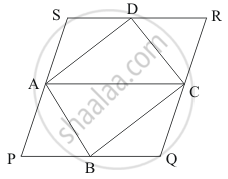
A and C are the midpoints of PS and QR respectively.
`AP = 1/2 SP`
`BP = 1/2 QR`
Now PQRS is a parallelogram which means
`PS = QR `
`1/2PS = 1/2 QR`
AP = CQ ……..(1)
Also, PS || QR
AP || CQ ……(2)
From 1 and 2 we get that APCQ is a parallelogram.
Since Parallelogram APCQ and ΔABC are on the base AC and between the same parallels AC and PQ.
`∴ ar (ΔABC) = 1/2 ar ("||"^(gm) APCQ)` ……(3)
Similarly ,
`ar (ΔADC ) = 1/2 ar ("||"^(gm) ACRS)` ……(4)
Adding 3 and 4 we get,
`ar (ΔABC ) + ar (ΔADC) = 1/2 ar ("||"^(gm) APCQ) + 1/2 ar("||"^(gm) ACRS)`
`ar (ABCD ) = 1/2 (ar ("||"^(gm) APCQ ) + ar ("||"^(gm) ACRS))`
`ar (ABCD ) = 1/2 (ar("||"^(gm) PQRS))`
`ar (ABCD ) = 1/2 (36)`
`ar (ABCD) = 18 cm^2`
APPEARS IN
संबंधित प्रश्न
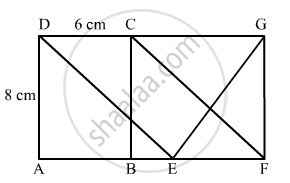
In the given figure, ABCD is a rectangle in which CD = 6 cm, AD = 8 cm. Find the area of parallelogram CDEF.
In a ΔABC, D, E, F are the mid-points of sides BC, CA and AB respectively. If ar (ΔABC) = 16cm2, then ar (trapezium FBCE) =
Medians of ΔABC intersect at G. If ar (ΔABC) = 27 cm2, then ar (ΔBGC) =
ABCD is a trapezium with parallel sides AB =a and DC = b. If E and F are mid-points of non-parallel sides AD and BC respectively, then the ratio of areas of quadrilaterals ABFEand EFCD is
So the area of piece A = ________ square cm
Karunya bought three fields.

Find the area of all three fields.
- Field (A) ____________ square metre.
- Field (B) ____________ square metre.
- Field (C) ____________ square metre.
An engineer who plans to build a compound wall on all sides of a house must find the area of the compound.
How will you decide? Discuss.
Find the area of the following figure by counting squares:
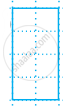
Find the area of the following figure by counting squares: