Advertisements
Advertisements
प्रश्न
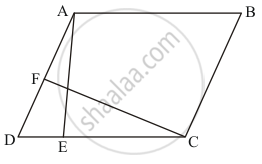
In the given figure, ABCD is a parallelogram. If AB = 12 cm, AE = 7.5 cm, CF = 15 cm, then AD =
Advertisements
उत्तर
Given: (1) ABCD is a parallelogram.
(2) AB = 12 cm
(3) AE = 7.5 cm
(4) CF = 15cm
To find: AD
Calculation: We know that,
Area of a parallelogram = base × height
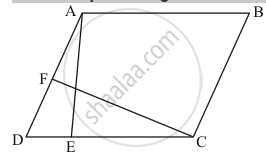
Area of a parallelogram ABCD = DC ×AE (with DC as base and AE as height) ……(1)
Area of a parallelogram ABCD = AD ×CF (with DC as base and AE as height) ……(2)
Since equation 1 and 2 both are Area of a parallelogram ABCD
`DC xx AE = AD xx CF`
`AD = (DC xx AE)/(CF)`
`AD = (AB xx AE)/(CF)` (AB = DC , opposite sides of parallelogram are eual )
`AD = (12 xx 7.5)/15`
AD = 6 cm
APPEARS IN
संबंधित प्रश्न
If P is any point in the interior of a parallelogram ABCD, then prove that area of the
triangle APB is less than half the area of parallelogram.
ABCD is a trapezium with parallel sides AB =a and DC = b. If E and F are mid-points of non-parallel sides AD and BC respectively, then the ratio of areas of quadrilaterals ABFEand EFCD is
The perimeter of a triangle ABC is 37 cm and the ratio between the lengths of its altitudes be 6: 5: 4. Find the lengths of its sides.
Let the sides be x cm, y cm, and (37 - x - y) cm. Also, let the lengths of altitudes be 6a cm, 5a cm, and 4a cm.
A floor is 40 m long and 15 m broad. It is covered with tiles, each measuring 60 cm by 50 cm. Find the number of tiles required to cover the floor.
Find the area of a rectangle whose length = 3.6 m breadth = 90 cm
Each side of a square is 7 m. If its each side be increased by 3 m, what will be the increase in its area.
The table given below contains some measures of the rectangle. Find the unknown values.
| Length | Breadth | Perimeter | Area |
| 13 cm | ? | 54 cm | ? |
So the area of piece A = ________ square cm
Find all the possible dimensions (in natural numbers) of a rectangle with a perimeter 36 cm and find their areas.
What is the area of a closed shape?
