Advertisements
Advertisements
प्रश्न
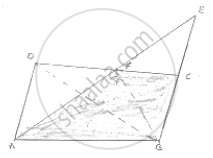
ABCD is a parallelogram in which BC is produced to E such that CE = BC. AE intersects
CD at F.
(i) Prove that ar (ΔADF) = ar (ΔECF)
(ii) If the area of ΔDFB = 3 cm2, find the area of ||gm ABCD.
Advertisements
उत्तर
In triangles and , ADF ECF we have
∠ADF = ∠ECF [Alternative interior angles, Since || AD BE]
AD = EC [ Since AD = BC = CE ]
And ∠DFA = ∠CFA [vertically opposite angles]
So, by AAS congruence criterion, we have
ΔADF ≅ ECF
⇒ area (ΔADF) = area (ΔECF) and DF = CF.
Now, DF = CF
⇒ BF is a madian in ΔBCD
⇒ area (ΔBCD) =2ar (ΔBDF)
⇒ area (ΔBCD) = 2× 3 cm2 =6cm2
Hence, ar (||gm ABCD) = 2ar (ΔBCD) 2 × 6cm2
=12cm2
APPEARS IN
संबंधित प्रश्न
ABCD is a parallelogram whose diagonals AC and BD intersect at O. A line through O
intersects AB at P and DC at Q. Prove that ar (Δ POA) = ar (Δ QOC).
ABCD is a parallelogram. E is a point on BA such that BE = 2 EA and F is a point on DC
such that DF = 2 FC. Prove that AE CF is a parallelogram whose area is one third of the
area of parallelogram ABCD.
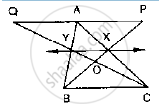
In the below fig. X and Y are the mid-points of AC and AB respectively, QP || BC and
CYQ and BXP are straight lines. Prove that ar (Δ ABP) = ar (ΔACQ).
A triangle and a parallelogram are on the same base and between the same parallels. The ratio of the areas of triangle and parallelogram is
ABCD is a rectangle with O as any point in its interior. If ar (ΔAOD) = 3 cm2 and ar (ΔABOC) = 6 cm2, then area of rectangle ABCD is
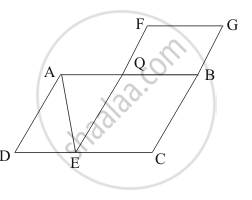
In the given figure, ABCD and FECG are parallelograms equal in area. If ar (ΔAQE) = 12 cm2, then ar (||gm FGBQ) =
Find the area of a square, whose side is: 4.1 cm.
What is the area of the rectangle? ________ square cm
Find all the possible dimensions (in natural numbers) of a rectangle with a perimeter 36 cm and find their areas.
Which unit is used to express area?
