Advertisements
Advertisements
प्रश्न
ABCD is a trapezium with parallel sides AB =a and DC = b. If E and F are mid-points of non-parallel sides AD and BC respectively, then the ratio of areas of quadrilaterals ABFEand EFCD is
विकल्प
a : b
(a + 3b): (3a + b)
(3a + b) : (a + 3b)
(2a + b) : (3a + b)
Advertisements
उत्तर
Given: (1) ABCD is a trapezium, with parallel sides AB and DC
(2) AB = a cm
(3) DC = b cm
(4) E is the midpoint of non parallel sides AD.
(5) G is the midpoint of non parallel sides BC.
To find: Ratio of the area of the Quadrilaterals ABFE and EFCD.
Calculation: We know that, ‘Area of a trapezium is half the product of its height and the sum of the parallel sides.’
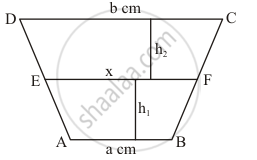
Since, E and F are mid points of AD and BC respectively, so h1 = h2
Area of trapezium ABFE
Area of trapezium ABFE`=1/2 (a + x) h_1 = 1/2 (a + x)h`
Area of trapezium EFCD = `1/2 (b+x)h_2 = 1/2 (b+ x) h`
Area of trapezium ABCD `= 1/2 (a+ b) (h_1 + h_2 ) = (a+b) h`
Now, Area (trap ABCD) = area (trap EFCD) + Area (ABFE)
Therefore,
(a + b) h = `1/2 ( a + x) h + 1/2 (b+x) h`
`⇒ A +b = (a+b)/2 +x`
`⇒x = (a+b)/2`
Thus,
`(Area (ABFE))/(Area (EFCD)) = (a+x)/(b +x) = (a +(a+b)/2)/(b + (a+b)/2)`
`⇒ (Area (ABFE))/(Area (EFCD)) = (3a +b)/(a + 3b)`
APPEARS IN
संबंधित प्रश्न
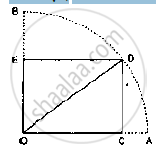
In the below fig. OCDE is a rectangle inscribed in a quadrant of a circle of radius 10 cm. If
OE = 2√5, find the area of the rectangle.
Let ABC be a triangle of area 24 sq. units and PQR be the triangle formed by the mid-points of the sides of Δ ABC. Then the area of ΔPQR is
The diagonal of a rectangular board is 1 m and its length is 96 cm. Find the area of the board.
What will happen to the area of a rectangle, if its length and breadth both are trebled?
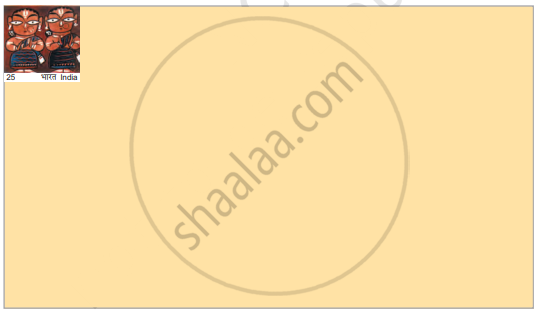
This stamp has an area of 4 square cm. Guess how many such stamps will cover this big rectangle.
Is the area of your belt the same as the area of the postcard? Why or why not?
Whose footprint is larger - yours or your friend’s?
Find the area of the following figure by counting squares:

Find the area of the following figure by counting squares:

Find the area of the following figure by counting squares: