Advertisements
Advertisements
Question
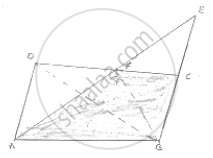
ABCD is a parallelogram in which BC is produced to E such that CE = BC. AE intersects
CD at F.
(i) Prove that ar (ΔADF) = ar (ΔECF)
(ii) If the area of ΔDFB = 3 cm2, find the area of ||gm ABCD.
Advertisements
Solution
In triangles and , ADF ECF we have
∠ADF = ∠ECF [Alternative interior angles, Since || AD BE]
AD = EC [ Since AD = BC = CE ]
And ∠DFA = ∠CFA [vertically opposite angles]
So, by AAS congruence criterion, we have
ΔADF ≅ ECF
⇒ area (ΔADF) = area (ΔECF) and DF = CF.
Now, DF = CF
⇒ BF is a madian in ΔBCD
⇒ area (ΔBCD) =2ar (ΔBDF)
⇒ area (ΔBCD) = 2× 3 cm2 =6cm2
Hence, ar (||gm ABCD) = 2ar (ΔBCD) 2 × 6cm2
=12cm2
APPEARS IN
RELATED QUESTIONS
D is the mid-point of side BC of ΔABC and E is the mid-point of BD. if O is the mid-point
of AE, prove that ar (ΔBOE) = `1/8` ar (Δ ABC).
ABC is a triangle in which D is the mid-point of BC. E and F are mid-points of DC and AErespectively. IF area of ΔABC is 16 cm2, find the area of ΔDEF.
ABCD is a parallelogram. P is the mid-point of AB. BD and CP intersect at Q such that CQ: QP = 3.1. If ar (ΔPBQ) = 10cm2, find the area of parallelogram ABCD.
Find the area of a rectangle whose length and breadth are 25 m and 16 cm.
Find the area of a square, whose side is: 7.2 cm.
Find the area of a square, whose side is: 4.5 cm.
Find the area of a square, whose side is: 4.1 cm.
Measure the length of the floor of your classroom in meters. Also, measure the width.
- What is the area of the floor of your classroom in square metres?
How will you decide? Discuss.
When using a square centimeter sheet for measurement, the area of one entire square equals:
