Advertisements
Advertisements
Question
PQRS is a trapezium having PS and QR as parallel sides. A is any point on PQ and B is a point on SR such that AB || QR. If area of ΔPBQ is 17cm2, find the area of ΔASR.
Advertisements
Solution
Given: Here from the given figure we get
(1) PQRS is a trapezium having PS||QR
(2) A is any point on PQ
(3) B is any point on SR
(4) AB||QR
(5) Area of ΔBPQ = 17 cm2
To find : Area of ΔASR
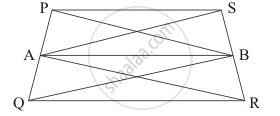
Calculation: We know that ‘If a triangle and a parallelogram are on the same base and the same parallels, the area of the triangle is equal to half the area of the parallelogram’
Here we can see that:
Area (ΔAPB) = Area (ΔABS) …… (1)
And, Area (ΔAQR) = Area (ΔABR) …… (2)
Therefore,
Area (ΔASR) = Area (ΔABS) + Area (ΔABR)
From equation (1) and (2), we have,
Area (ΔASR) = Area (ΔAPB) + Area (ΔAQR)
⇒ Area (ΔASR) = Area (ΔBPQ) = 17 cm2
Hence, the area of the triangle ΔASR is 17 cm2.
APPEARS IN
RELATED QUESTIONS
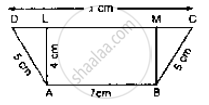
In the below fig. ABCD is a trapezium in which AB = 7 cm, AD = BC = 5 cm, DC = x cm,
and distance between AB and DC is 4cm. Find the value of x and area of trapezium ABCD.
ABCD is a parallelogram. P is the mid-point of AB. BD and CP intersect at Q such that CQ: QP = 3.1. If ar (ΔPBQ) = 10cm2, find the area of parallelogram ABCD.
Diagonal AC and BD of trapezium ABCD, in which AB || DC, intersect each other at O. The triangle which is equal in area of ΔAOD is
ABCD is a trapezium in which AB || DC. If ar (ΔABD) = 24 cm2 and AB = 8 cm, then height of ΔABC is
ABCD is a trapezium with parallel sides AB =a and DC = b. If E and F are mid-points of non-parallel sides AD and BC respectively, then the ratio of areas of quadrilaterals ABFEand EFCD is
Measure the length of the floor of your classroom in meters. Also measure the width.
- If you want to move around easily then how many children do you think should be there in one square meter?
The amount of region enclosed by a plane closed figure is called its ______.
How will you decide? Discuss.
Find the area of the following figure by counting squares:

Find the area of the following figure by counting squares:

