Advertisements
Advertisements
Question
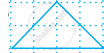
Let ABC be a triangle of area 24 sq. units and PQR be the triangle formed by the mid-points of the sides of Δ ABC. Then the area of ΔPQR is
Options
12 sq. units
6 sq. units
4 sq. units
3 sq. units
Advertisements
Solution
Given: (1) The Area of ΔABC = 24 sq units.
(2) ΔPQR is formed by joining the midpoints of ΔABC
To find: The area of ΔPQR
Calculation: In ΔABC, we have

Since Q and R are the midpoints of BC and AC respectively.
∴ PQ || BA ⇒ PQ || BP
Similarly, RQ || BP. So BQRP is a parallelogram.
Similarly APRQ and PQCR are parallelograms.
We know that diagonal of a parallelogram bisect the parallelogram into two triangles of equal area.
Now, PR is a diagonal of ||gmAPQR.
∴ Area of ΔAPR = Area of ΔPQR ……(1)
Similarly,
PQ is a diagonal of ||gm PBQR
∴ Area of ΔPQR = Area of ΔPBQ ……(2)
QR is the diagonal of ||gm PQCR
∴ Area of ΔPQR = Area of ΔRCQ ……(3)
From (1), (2), (3) we have
Area of ΔAPR = Area of ΔPQR = Area of ΔPBQ = Area of ΔRCQ
But
Area of ΔAPR + Area of ΔPQR + Area of ΔPBQ + Area of ΔRCQ = Area of ΔABC
4(Area of ΔPBQ) = Area of ΔABC
`= 1/4 `Area of ΔABC
∴ Area of ΔPBQ `= 1/4 (24)`
= 6 sq units
APPEARS IN
RELATED QUESTIONS
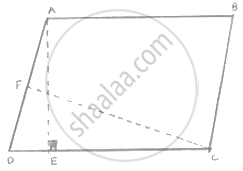
In fig below, ABCD is a parallelogram, AE ⊥ DC and CF ⊥ AD. If AB = 16 cm, AE = 8
cm and CF = 10 cm, find AD.
Let ABCD be a parallelogram of area 124 cm2. If E and F are the mid-points of sides AB and
CD respectively, then find the area of parallelogram AEFD.
If P is any point in the interior of a parallelogram ABCD, then prove that area of the
triangle APB is less than half the area of parallelogram.
A point D is taken on the side BC of a ΔABC such that BD = 2DC. Prove that ar(Δ ABD) =
2ar (ΔADC).
ABCD is a parallelogram. P is any point on CD. If ar (ΔDPA) = 15 cm2 and ar (ΔAPC) = 20 cm2, then ar (ΔAPB) =
ABCD is a trapezium in which AB || DC. If ar (ΔABD) = 24 cm2 and AB = 8 cm, then height of ΔABC is
A floor is 40 m long and 15 m broad. It is covered with tiles, each measuring 60 cm by 50 cm. Find the number of tiles required to cover the floor.
Who had the bigger piece? How much bigger?
Each line gives a story. You have to choose the question which makes the best story problem. The first one is already marked.
- A shopkeeper has 204 eggs. He puts them in egg trays. Each tray has 12 eggs.
a) How many more eggs will he need? b) How many fresh eggs does he sell? c) How many egg trays does he need?
Find the area of the following figure by counting squares: