Advertisements
Advertisements
Question
Find all the possible dimensions (in natural numbers) of a rectangle with a perimeter 36 cm and find their areas.
Advertisements
Solution
Perimeter of the rectangle = 36 cm
⇒ 2(Length + Breadth) = 36 cm
⇒ Length + Breadth = `36/2` cm = 18 cm
∴ The possible dimensions of the rectangle and their areas are as follows:
| Dimensions | Area |
| 1 cm × 17 cm | 17 cm2 |
| 2 cm × 16 cm | 32 cm2 |
| 3 cm × 15 cm | 45 cm2 |
| 4 cm × 14 cm | 56 cm2 |
| 5 cm × 13 cm | 65 cm2 |
| 6 cm × 12 cm | 72 cm2 |
| 7 cm × 11 cm | 77 cm2 |
| 8 cm × 10 cm | 80 cm2 |
| 9 cm × 9 cm | 81 cm2 |
APPEARS IN
RELATED QUESTIONS
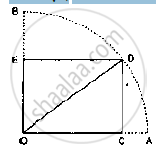
In the below fig. OCDE is a rectangle inscribed in a quadrant of a circle of radius 10 cm. If
OE = 2√5, find the area of the rectangle.
Let ABC be a triangle of area 24 sq. units and PQR be the triangle formed by the mid-points of the sides of Δ ABC. Then the area of ΔPQR is
The figure obtained by joining the mid-points of the adjacent sides of a rectangle of sides 8 cm and 6 cm is ______.
Find the area of a rectangle whose length and breadth are 25 m and 16 cm.
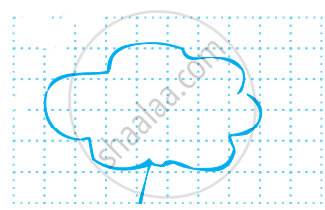
By counting squares, estimate the area of the figure.
Karunya bought three fields.

Find the area of all three fields.
- Field (A) ____________ square metre.
- Field (B) ____________ square metre.
- Field (C) ____________ square metre.
Each line gives a story. You have to choose the question which makes the best story problem. The first one is already marked.
- 352 children from a school went on a camping trip. Each tent had a group of 4 children.
a) How many children did each tent have? b) How many tents do they need? c) How many children in all are in the school?
An engineer who plans to build a compound wall on all sides of a house must find the area of the compound.
Find the area of the following figure by counting squares:

If a figure contains only 8 fully-filled squares and no partial squares, what is its area?
