Advertisements
Advertisements
Question
ABCD is a parallelogram. P is any point on CD. If ar (ΔDPA) = 15 cm2 and ar (ΔAPC) = 20 cm2, then ar (ΔAPB) =
Options
15 cm2
20 cm2
35 cm2
30 cm2
Advertisements
Solution
Given: (1) ABCD is a parallelogram
(2) P is any point on CD
(3) Area of ΔDPA = 15 cm2
(4) Area of ΔAPC = 20 cm2
To find: Area of ΔAPB
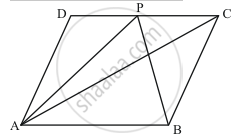
Calculation: We know that , “If a parallelogram and a a triangle are on the base between the same parallels, the area of triangle is equal to half the area of the parallelogram.”
Here , ΔAPB and ΔACB are on the same base and between the same parallels.
(since AC is the diagonal of parallelogram ABCD, diagonal of a parallelogram divides the parallelogram in two triangles of equal area)
ar (ΔACB ) = ar (ΔAPB)
ar (ΔACB) = ar (ΔADC)
ar (ΔACB) = Area of ΔADP + Area of ΔAPC
= 20 +15
= 35 cm2
Area of ΔACB = 35 cm2
APPEARS IN
RELATED QUESTIONS
The median of a triangle divides it into two ______.
The mid-points of the sides of a triangle ABC along with any of the vertices as the fourth point make a parallelogram of area equal to ______.
The side of a square field is 16 m. What will be increase in its area, if each of its sides is increased by 4 m?
The table given below contains some measures of the rectangle. Find the unknown values.
| Length | Breadth | Perimeter | Area |
| ? | 15 cm | 60 cm | ? |
So the area of piece A = ________ square cm
This stamp has an area of 4 square cm. Guess how many such stamps will cover this big rectangle.
Each line gives a story. You have to choose the question which makes the best story problem. The first one is already marked.
- A shopkeeper has 204 eggs. He puts them in egg trays. Each tray has 12 eggs.
a) How many more eggs will he need? b) How many fresh eggs does he sell? c) How many egg trays does he need?
Measure the length of the floor of your classroom in meters. Also measure the width.
- If you want to move around easily then how many children do you think should be there in one square meter?
A magazine charges Rs 300 per 10 sq cm area for advertising. A company decided to order a half page advertisment. If each page of the magazine is 15 cm × 24 cm, what amount will the company has to pay for it?
When using a square centimeter sheet for measurement, the area of one entire square equals:
