Advertisements
Advertisements
Question
In a ΔABC, D, E, F are the mid-points of sides BC, CA and AB respectively. If ar (ΔABC) = 16cm2, then ar (trapezium FBCE) =
Options
4 cm2
8 cm2
12 cm2
10 cm2
Advertisements
Solution
Given: In ΔABC
(1) D is the midpoint of BC
(2) E is the midpoint of CA
(3) F is the midpoint of AB
(4) Area of ΔABC = 16 cm2
To find: The area of Trapezium FBCE
Calculation: Here we can see that in the given figure,
Area of trapezium FBCE = Area of ||gm FBDE + Area of ΔCDE

Since D and E are the midpoints of BC and AC respectively.
∴ DE || BA ⇒ DE || BF
Similarly, FE || BD. So BDEF is a parallelogram.
Now, DF is a diagonal of ||gm BDEF.
∴ Area of ΔBDF = Area of ΔDEF ……(1)
Similarly,
DE is a diagonal of ||gm DCEF
∴ Area of ΔDCE = Area of ΔDEF ……(2)
FE is the diagonal of ||gm AFDE
∴ Area of ΔAFE = Area of ΔDEF ……(3)
From (1), (2), (3) we have
Area of ΔBDF = Area of ΔDCF = Area of ΔAFE = Area of ΔDEF
But
Area of ΔBDF + Area of ΔDCE + Area of ΔAFE + Area of ΔDEF = Area of ΔABC
∴ 4 Area of ΔBDF = Area of ΔABC
Area of ΔBDF = `1/4` Area of ΔABC
= `1/4 (16)`
= 4 cm2
Area of ΔBDF = Area of ΔDCE = Area of ΔAFE = Area of ΔDEF = 4 cm2 …….(4)
Now
Area of trapezium FBCE = Area of || FBDE + Area of ΔCDE
=(Area of ΔBDF + Area of ΔDEF ) + Area of ΔCDE
= 4 + 4+ 4 (from 4)
= 12 cm2
Hence we get
Area of trapezium FBCE = 12 cm2
APPEARS IN
RELATED QUESTIONS
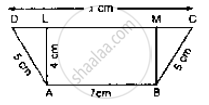
In the below fig. ABCD is a trapezium in which AB = 7 cm, AD = BC = 5 cm, DC = x cm,
and distance between AB and DC is 4cm. Find the value of x and area of trapezium ABCD.
Diagonals AC and BD of a quadrilateral ABCD intersect each other at P. Show that:
ar(ΔAPB) × ar(ΔCPD) = ar(ΔAPD) × ar (ΔBPC)
If P is any point in the interior of a parallelogram ABCD, then prove that area of the
triangle APB is less than half the area of parallelogram.
ABCD is a parallelogram in which BC is produced to E such that CE = BC. AE intersects
CD at F.
(i) Prove that ar (ΔADF) = ar (ΔECF)
(ii) If the area of ΔDFB = 3 cm2, find the area of ||gm ABCD.
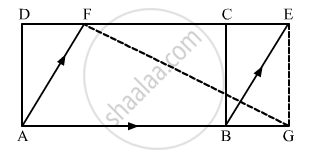
In the given figure, ABCD is a rectangle with sides AB = 10 cm and AD = 5 cm. Find the area of ΔEFG.
Two parallelograms are on the same base and between the same parallels. The ratio of their areas is
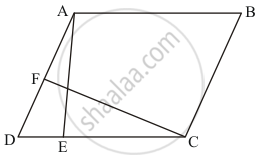
In the given figure, ABCD is a parallelogram. If AB = 12 cm, AE = 7.5 cm, CF = 15 cm, then AD =
The medians of a triangle ABC intersect each other at point G. If one of its medians is AD,
prove that:
(i) Area ( ΔABD ) = 3 x Area ( ΔBGD )
(ii) Area ( ΔACD ) = 3 x Area ( ΔCGD )
(iii) Area ( ΔBGC ) = `1/3` x Area ( ΔABC ).
Measure the length of the floor of your classroom in meters. Also measure the width.
- If you want to move around easily then how many children do you think should be there in one square meter?
Find the area of the following figure by counting squares:

