Advertisements
Advertisements
Question
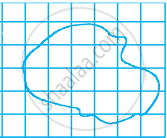
Find the area of the following figure by counting squares:
Advertisements
Solution
From the given figure, we observe
| Covered Area | Number | Area estimate (square units) |
| Fully filled squares | 8 | 8 |
| Half filled squares | – | – |
| More than half-filled squares | 10 | 10 |
| Less than half-filled squares | 9 | 0 |
Therefore total area = 8 + 10 = 18 square units.
RELATED QUESTIONS
ABC is a triangle in which D is the mid-point of BC. E and F are mid-points of DC and AErespectively. IF area of ΔABC is 16 cm2, find the area of ΔDEF.
In a ΔABC if D and E are mid-points of BC and AD respectively such that ar (ΔAEC) = 4cm2, then ar (ΔBEC) =
Find the area of a square, whose side is: 7.2 cm.
The side of a square field is 16 m. What will be increase in its area, if each of its sides is doubled?
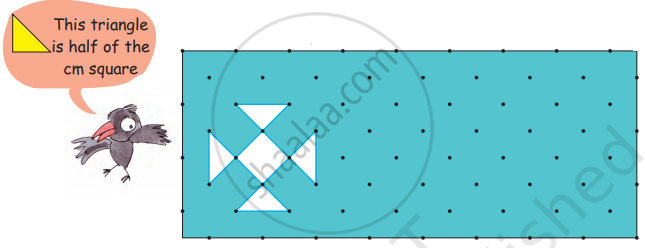
How many tiles like the triangle given here will fit in the white design?
Area of design = ________ square cm
Measure the length of the floor of your classroom in meters. Also, measure the width.
- So how many children can sit in one square meter?
Find all the possible dimensions (in natural numbers) of a rectangle with a perimeter 36 cm and find their areas.
Whose footprint is larger - yours or your friend’s?
Find the area of the following figure by counting squares:

Find the area of the following figure by counting squares:

