Advertisements
Advertisements
Question
In the given figure, ABCD and FECG are parallelograms equal in area. If ar (ΔAQE) = 12 cm2, then ar (||gm FGBQ) =
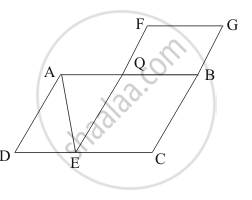
Options
12 cm2
20 cm2
24 cm2
36 cm2
Advertisements
Solution
Given: (1) Area of parallelogram ABCD is equal to Area of parallelogram FECG.
(2) If Area of ΔAQE is 12cm.
To find: Area of parallelogram FGBQ
Calculation: We know that diagonal of a parallelogram divides the parallelogram into two triangles of equal area.
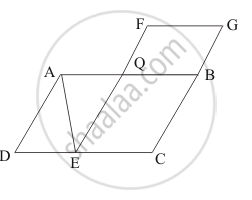
It is given that,
`ar ("||"^(gm)ABCD) = ar ("||"^(gm) FECG)`
`⇒ ar (ΔADE) + ar (ΔAQE) + ar ( "||"^(gm) QECB ) = ar ("||"^(gm) QECB) + ar ("||"^(gm) FQBG)`
`⇒ ar (ΔADE) + ar (ΔAQE) = ar "||"^(gm) FQBG`
`⇒ 2ar (ΔAQE) = ar ( "||"^(gm) FQBG)`
`⇒ar ( "||"^(gm) FQBG) = 2ar (ΔAQE) `
`⇒ar ( "||"^(gm) FQBG) = 2 xx 12`
`⇒ar ( "||"^(gm) FQBG) = 24 cm^2`
APPEARS IN
RELATED QUESTIONS
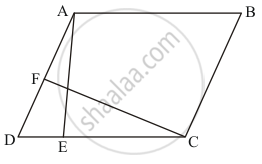
In the given figure, ABCD is a parallelogram. If AB = 12 cm, AE = 7.5 cm, CF = 15 cm, then AD =
The medians of a triangle ABC intersect each other at point G. If one of its medians is AD,
prove that:
(i) Area ( ΔABD ) = 3 x Area ( ΔBGD )
(ii) Area ( ΔACD ) = 3 x Area ( ΔCGD )
(iii) Area ( ΔBGC ) = `1/3` x Area ( ΔABC ).
Find the area of a rectangle whose length = 24 cm breadth =180 mm
The side of a square field is 16 m. What will be increase in its area, if each of its sides is increased by 4 m?
Is the area of your belt the same as the area of the postcard? Why or why not?
Look at the table. If you were to write the area of each of these which column would you choose? Make a (✓).
| Square cm |
Square meter |
Square km |
|
| Handkerchief | ✓ | ||
| Sari | |||
| Page of your book | |||
| School land | |||
| Total land of a city | |||
| Door of your classroom | |||
| Chair seat | |||
| Blackboard | |||
| Indian flag | |||
| Land over which a river flows |
Karunya bought three fields.

Find the area of all three fields.
- Field (A) ____________ square metre.
- Field (B) ____________ square metre.
- Field (C) ____________ square metre.
Area of a rectangle with length 5 cm and breadth 3 cm is ______.
How will you decide? Discuss.
Find the area of the following figure by counting squares:

