Advertisements
Advertisements
Question
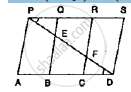
In below fig., PSDA is a parallelogram in which PQ = QR = RS and AP || BQ || CR. Prove
that ar (Δ PQE) = ar (ΔCFD).
Advertisements
Solution
Given that PSDA is a parallelogram
Since, AP || BQ ||CR || DS and AD || PS
∴PQ = CD .....(1)
In ΔBED,C is the midpoint of BD and CF || BE
∴ F is the midpoint of ED
⇒ EF = PE
similarly
EF = FD
∴ PE = FD ........ (2)
In Δ SPQE and CFD , WE have
PE = FD
∠EDQ = ∠FDC, [Alternative angles]
And PQ = CD
So by SAS congruence criterion, we have . ΔPQE ≅ ΔDCF .
APPEARS IN
RELATED QUESTIONS
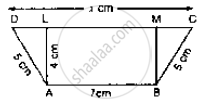
In the below fig. ABCD is a trapezium in which AB = 7 cm, AD = BC = 5 cm, DC = x cm,
and distance between AB and DC is 4cm. Find the value of x and area of trapezium ABCD.
ABCD is a parallelogram in which BC is produced to E such that CE = BC. AE intersects
CD at F.
(i) Prove that ar (ΔADF) = ar (ΔECF)
(ii) If the area of ΔDFB = 3 cm2, find the area of ||gm ABCD.
PQRS is a rectangle inscribed in a quadrant of a circle of radius 13 cm. A is any point on PQ. If PS = 5 cm, then find ar (ΔRAS)
Find the area of a rectangle whose length and breadth are 25 m and 16 cm.
Nasreena is a farmer who wants to divide her land equally among her three children — Chumki, Jhumri, and Imran. She wants to divide the land so that each piece of land has one tree. Her land looks like this.

- Can you divide the land equally? Show how you will divide it. Remember each person has to get a tree. Colour each person’s piece of land differently.
Karunya bought three fields.

Find the area of all three fields.
- Field (A) ____________ square metre.
- Field (B) ____________ square metre.
- Field (C) ____________ square metre.
Area of a rectangle with length 5 cm and breadth 3 cm is ______.
Find all the possible dimensions (in natural numbers) of a rectangle with a perimeter 36 cm and find their areas.
Is the area of both your footprints the same?
Find the area of the following figure by counting squares: