Advertisements
Advertisements
Question
Length of a rectangle is 30 m and its breadth is 20 m. Find the increase in its area if its length is increased by 10 m and its breadth is doubled.
Advertisements
Solution
Length of a rectangle (l) = 30 m,
Breadth of the rectangle (b) = 20 m
Area of rectangle = l x b
= 30 x 20 = 600 m2
Since, the length its increased by 10 m and breadth is doubled
∴New length (l) = (30 + 10) m = 40 m
and new breadth = (20 x 2) m = 40 m
∴New area = l x b = 40 x 40 m2 = 1600 m2
Hence, the increase in the area = (1600 – 600) m2
= 1000 m2
APPEARS IN
RELATED QUESTIONS
If ABCD is a parallelogram, then prove that
𝑎𝑟 (Δ𝐴𝐵𝐷) = 𝑎𝑟 (Δ𝐵𝐶𝐷) = 𝑎𝑟 (Δ𝐴𝐵𝐶) = 𝑎𝑟 (Δ𝐴𝐶𝐷) = `1/2` 𝑎𝑟 (||𝑔𝑚 𝐴𝐵𝐶𝐷) .
Diagonals AC and BD of a quadrilateral ABCD intersect each other at P. Show that:
ar(ΔAPB) × ar(ΔCPD) = ar(ΔAPD) × ar (ΔBPC)
The median of a triangle divides it into two ______.
Find the area of a rectangle whose length = 3.6 m breadth = 90 cm
Find the area of a rectangle whose length = 24 cm breadth =180 mm
What will happen to the area of a rectangle, if its length and breadth both are trebled?
Which has the bigger area - one of your footprints or the page of this book?
In the same way, find the area of piece B.
Each line gives a story. You have to choose the question which makes the best story problem. The first one is already marked.
- A shopkeeper has 50 boxes. There are 48 fruits in one box.
Tick the one question which matches with the given problem.
Explain why (a) and (c) are not good choices.a) How much will the shopkeeper pay in all? b) How many fruits are there in all? ✓ c) How many more boxes will he need?
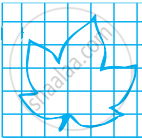
Find the area of the following figure by counting squares: