Advertisements
Advertisements
Question
What will happen to the area of a rectangle, if its length and breadth both are trebled?
Advertisements
Solution
Let the original length of the rectangle = l and its original breadth = b
∴ its original area = length x breadth i.e A = l – b i. e.
Since,
Increased length -=3l
and, increased breadth = 3b
∴ New area = 3l x 3b = 9 x l x b [∵A = l x b]
⇒ Area of the new rectangle = 9 times than area of original rectangle
APPEARS IN
RELATED QUESTIONS
If ABCD is a parallelogram, then prove that
𝑎𝑟 (Δ𝐴𝐵𝐷) = 𝑎𝑟 (Δ𝐵𝐶𝐷) = 𝑎𝑟 (Δ𝐴𝐵𝐶) = 𝑎𝑟 (Δ𝐴𝐶𝐷) = `1/2` 𝑎𝑟 (||𝑔𝑚 𝐴𝐵𝐶𝐷) .
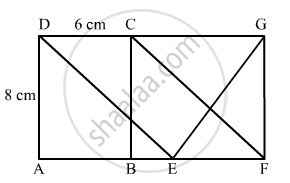
In the given figure, ABCD is a rectangle in which CD = 6 cm, AD = 8 cm. Find the area of parallelogram CDEF.
Let ABC be a triangle of area 24 sq. units and PQR be the triangle formed by the mid-points of the sides of Δ ABC. Then the area of ΔPQR is
Medians of ΔABC intersect at G. If ar (ΔABC) = 27 cm2, then ar (ΔBGC) =
Find the area of a rectangle whose length and breadth are 25 m and 16 cm.
Find the area of a rectangle whose length = 3.6 m breadth = 90 cm
Each side of a square is 7 m. If its each side be increased by 3 m, what will be the increase in its area.
Is the area of the blue shape more than the area of the yellow shape? Why?


Find the area of the following figure by counting squares:

Find the area of the following figure by counting squares: