Advertisements
Advertisements
प्रश्न
Length of a rectangle is 30 m and its breadth is 20 m. Find the increase in its area if its length is increased by 10 m and its breadth is doubled.
Advertisements
उत्तर
Length of a rectangle (l) = 30 m,
Breadth of the rectangle (b) = 20 m
Area of rectangle = l x b
= 30 x 20 = 600 m2
Since, the length its increased by 10 m and breadth is doubled
∴New length (l) = (30 + 10) m = 40 m
and new breadth = (20 x 2) m = 40 m
∴New area = l x b = 40 x 40 m2 = 1600 m2
Hence, the increase in the area = (1600 – 600) m2
= 1000 m2
APPEARS IN
संबंधित प्रश्न
In Q. No 1, if AD = 6 cm, CF = 10 cm, and AE = 8cm, find AB.
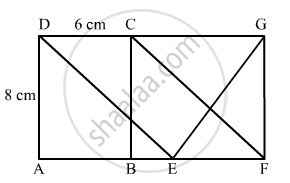
In the given figure, ABCD is a rectangle in which CD = 6 cm, AD = 8 cm. Find the area of parallelogram CDEF.
ABCD is a parallelogram. P is the mid-point of AB. BD and CP intersect at Q such that CQ: QP = 3.1. If ar (ΔPBQ) = 10cm2, find the area of parallelogram ABCD.
The mid-points of the sides of a triangle ABC along with any of the vertices as the fourth point make a parallelogram of area equal to ______.
The perimeter of a triangle ABC is 37 cm and the ratio between the lengths of its altitudes be 6: 5: 4. Find the lengths of its sides.
Let the sides be x cm, y cm, and (37 - x - y) cm. Also, let the lengths of altitudes be 6a cm, 5a cm, and 4a cm.
A floor is 40 m long and 15 m broad. It is covered with tiles, each measuring 60 cm by 50 cm. Find the number of tiles required to cover the floor.
Find the area and perimeter of the following parallelograms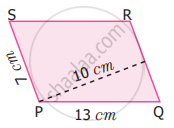
Altogether how many squares can be arranged on it?
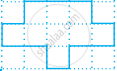
Find the area of the following figure by counting squares:
If a figure contains only 8 fully-filled squares and no partial squares, what is its area?
