Advertisements
Advertisements
प्रश्न
Each side of a square is 7 m. If its each side be increased by 3 m, what will be the increase in its area.
Advertisements
उत्तर
Each side of square = 7 m
∴ Area of square = (side)²= (7m)²
= 7m x 7m = 49m²
∵ Side increased by 3 m
∴ Total length of side will be = 3 m + 7 m = 10m
∴ Area of square = (10 m)²= 10m x 10 m = 100 m²
∴ Increase in area = 100 m² – 49 m² = 51 m²
APPEARS IN
संबंधित प्रश्न
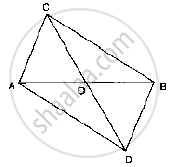
In the below Fig, ABC and ABD are two triangles on the base AB. If line segment CD is
bisected by AB at O, show that ar (Δ ABC) = ar (Δ ABD)
The perimeter of a triangle ABC is 37 cm and the ratio between the lengths of its altitudes be 6: 5: 4. Find the lengths of its sides.
Let the sides be x cm, y cm, and (37 - x - y) cm. Also, let the lengths of altitudes be 6a cm, 5a cm, and 4a cm.
The diagonal of a rectangular board is 1 m and its length is 96 cm. Find the area of the board.
Find the area of a rectangle whose length = 15 cm breadth = 6.4 cm
Find the area of a rectangle whose length = 3.6 m breadth = 90 cm
Find the area of a square, whose side is: 4.1 cm.
Find the area and perimeter of the following parallelograms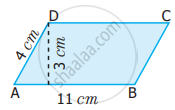
Which has the smaller area - two five-rupee notes together or a hundred rupee notes?
Each line gives a story. You have to choose the question which makes the best story problem. The first one is already marked.
- 352 children from a school went on a camping trip. Each tent had a group of 4 children.
a) How many children did each tent have? b) How many tents do they need? c) How many children in all are in the school?
If a figure contains only 8 fully-filled squares and no partial squares, what is its area?
