Advertisements
Advertisements
प्रश्न
Find the area and perimeter of the following parallelograms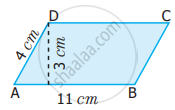
Advertisements
उत्तर
Given: base b = 11 cm
height h = 3 cm
Area of the parallelogram = b × h sq.units
= 11 × 3 cm2
= 33 cm2
Also perimeter of a parallelogram = Sum of 4 sides
= 11 cm + 4 cm + 11 cm + 4 cm
= 30 cm
Area = 33 cm2, Perimeter = 30 cm.
APPEARS IN
संबंधित प्रश्न
Let ABCD be a parallelogram of area 124 cm2. If E and F are the mid-points of sides AB and
CD respectively, then find the area of parallelogram AEFD.
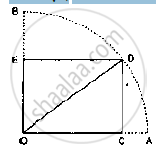
In the below fig. OCDE is a rectangle inscribed in a quadrant of a circle of radius 10 cm. If
OE = 2√5, find the area of the rectangle.
A point D is taken on the side BC of a ΔABC such that BD = 2DC. Prove that ar(Δ ABD) =
2ar (ΔADC).
Find the area of a square, whose side is: 4.5 cm.
Find the area of a square, whose side is: 4.1 cm.
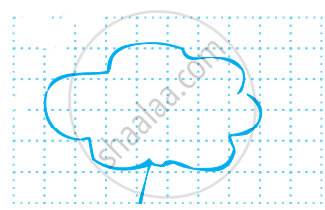
By counting squares, estimate the area of the figure.
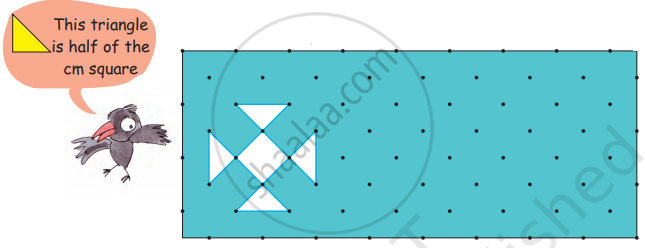
How many tiles like the triangle given here will fit in the white design?
Area of design = ________ square cm
The King was very happy with carpenters Cheggu and Anar. They had made a very big and beautiful bed for him. So as gifts the king wanted to give some land to Cheggu, and some gold to Anar. Cheggu was happy. He took 100 meters of wire and tried to make different rectangles.
He made a 10 m × 40 m rectangle. Its area was 400 square meters. So he next made a 30 m × 20 m rectangle.
- What other rectangles can he make with 100 meters of wire? Discuss which of these rectangles will have the biggest area.
How will you decide? Discuss.
Find the area of the following figure by counting squares:

