Advertisements
Advertisements
प्रश्न
A point D is taken on the side BC of a ΔABC such that BD = 2DC. Prove that ar(Δ ABD) =
2ar (ΔADC).
Advertisements
उत्तर
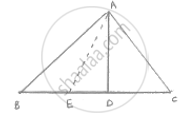
GIven that ,
In ΔABC, BD = 2 DC
To prove: ar ( ΔABD ) = 2ar (ΔADC)
Construction: Take a point E on BD such that BE = ED
Proof : Since, BE = ED and 2 BD = 2DC
Then, BE = ED = DC
We know that median of Δledivides it into two equal Δles
∴ In , ΔABD , AE is a median
Then, area (ΔABD) 2ar (ΔAED) .....(1)
In , ΔAEC , AD is a median
Then area (ΔAED) = area (ΔADC) ...... (2)
Compare equation (1) and (2)
Area (ΔABD) = 2ar (ΔADC).
APPEARS IN
संबंधित प्रश्न
If P is any point in the interior of a parallelogram ABCD, then prove that area of the
triangle APB is less than half the area of parallelogram.
PQRS is a rectangle inscribed in a quadrant of a circle of radius 13 cm. A is any point on PQ. If PS = 5 cm, then find ar (ΔRAS)
The area of the figure formed by joining the mid-points of the adjacent sides of a rhombus with diagonals 16 cm and 12 cm is
Diagonal AC and BD of trapezium ABCD, in which AB || DC, intersect each other at O. The triangle which is equal in area of ΔAOD is
Find the area of a square, whose side is: 4.1 cm.
By counting squares, estimate the area of the figure.

By counting squares, estimate the area of the figure.

This stamp has an area of 4 square cm. Guess how many such stamps will cover this big rectangle.

What is the area of the rectangle? ________ square cm
Whose footprint is larger - yours or your friend’s?
