Advertisements
Advertisements
प्रश्न
In Q. No 1, if AD = 6 cm, CF = 10 cm, and AE = 8cm, find AB.
Advertisements
उत्तर
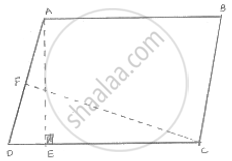
We know that,
Area of parallelogram ABCD = AD × CF ……(1)
Again area of parallelogram ABCD = DC × AE ……(2)
Compare equation (1) and equation (2)
AD × CF = DC × AE
⇒ 6 × 10 = D × B
⇒ ` D = 60 /8 = 7. 5cm`
∴ AB = DC = 7 . 5cm [ ∴ Opposite sides of a parallelogram are equal ]
APPEARS IN
संबंधित प्रश्न
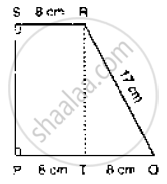
Compute the area of trapezium PQRS is Fig. below.
If ABC and BDE are two equilateral triangles such that D is the mid-point of BC, then find ar (ΔABC) : ar (ΔBDE).
Let ABC be a triangle of area 24 sq. units and PQR be the triangle formed by the mid-points of the sides of Δ ABC. Then the area of ΔPQR is
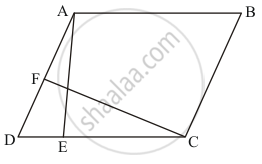
In the given figure, ABCD is a parallelogram. If AB = 12 cm, AE = 7.5 cm, CF = 15 cm, then AD =
What will happen to the area of a rectangle, if its length and breadth both are trebled?
Which has the smaller area - two five-rupee notes together or a hundred rupee notes?
In the same way, find the area of piece B.
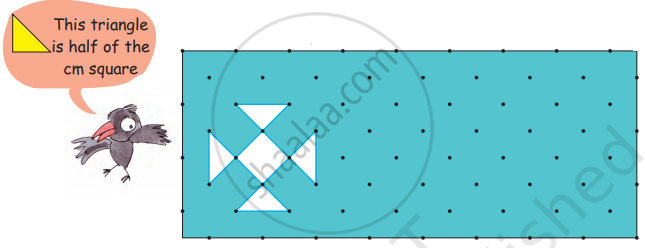
How many tiles like the triangle given here will fit in the white design?
Area of design = ________ square cm
Find the area of the following figure by counting squares:

If a figure contains only 8 fully-filled squares and no partial squares, what is its area?
