Advertisements
Advertisements
प्रश्न
In a ΔABC, D, E, F are the mid-points of sides BC, CA and AB respectively. If ar (ΔABC) = 16cm2, then ar (trapezium FBCE) =
पर्याय
4 cm2
8 cm2
12 cm2
10 cm2
Advertisements
उत्तर
Given: In ΔABC
(1) D is the midpoint of BC
(2) E is the midpoint of CA
(3) F is the midpoint of AB
(4) Area of ΔABC = 16 cm2
To find: The area of Trapezium FBCE
Calculation: Here we can see that in the given figure,
Area of trapezium FBCE = Area of ||gm FBDE + Area of ΔCDE

Since D and E are the midpoints of BC and AC respectively.
∴ DE || BA ⇒ DE || BF
Similarly, FE || BD. So BDEF is a parallelogram.
Now, DF is a diagonal of ||gm BDEF.
∴ Area of ΔBDF = Area of ΔDEF ……(1)
Similarly,
DE is a diagonal of ||gm DCEF
∴ Area of ΔDCE = Area of ΔDEF ……(2)
FE is the diagonal of ||gm AFDE
∴ Area of ΔAFE = Area of ΔDEF ……(3)
From (1), (2), (3) we have
Area of ΔBDF = Area of ΔDCF = Area of ΔAFE = Area of ΔDEF
But
Area of ΔBDF + Area of ΔDCE + Area of ΔAFE + Area of ΔDEF = Area of ΔABC
∴ 4 Area of ΔBDF = Area of ΔABC
Area of ΔBDF = `1/4` Area of ΔABC
= `1/4 (16)`
= 4 cm2
Area of ΔBDF = Area of ΔDCE = Area of ΔAFE = Area of ΔDEF = 4 cm2 …….(4)
Now
Area of trapezium FBCE = Area of || FBDE + Area of ΔCDE
=(Area of ΔBDF + Area of ΔDEF ) + Area of ΔCDE
= 4 + 4+ 4 (from 4)
= 12 cm2
Hence we get
Area of trapezium FBCE = 12 cm2
APPEARS IN
संबंधित प्रश्न
If ABC and BDE are two equilateral triangles such that D is the mid-point of BC, then find ar (ΔABC) : ar (ΔBDE).
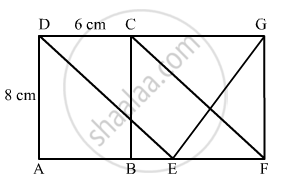
In the given figure, ABCD is a rectangle in which CD = 6 cm, AD = 8 cm. Find the area of parallelogram CDEF.
ABCD is a parallelogram. P is any point on CD. If ar (ΔDPA) = 15 cm2 and ar (ΔAPC) = 20 cm2, then ar (ΔAPB) =
A floor is 40 m long and 15 m broad. It is covered with tiles, each measuring 60 cm by 50 cm. Find the number of tiles required to cover the floor.
The side of a square field is 16 m. What will be increase in its area, if each of its sides is increased by 4 m?
Find the area and perimeter of the following parallelograms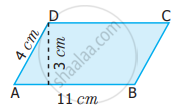
The King was very happy with carpenters Cheggu and Anar. They had made a very big and beautiful bed for him. So as gifts the king wanted to give some land to Cheggu, and some gold to Anar. Cheggu was happy. He took 100 meters of wire and tried to make different rectangles.
He made a 10 m × 40 m rectangle. Its area was 400 square meters. So he next made a 30 m × 20 m rectangle.
- What other rectangles can he make with 100 meters of wire? Discuss which of these rectangles will have the biggest area.
Each line gives a story. You have to choose the question which makes the best story problem. The first one is already marked.
- A shopkeeper has 204 eggs. He puts them in egg trays. Each tray has 12 eggs.
a) How many more eggs will he need? b) How many fresh eggs does he sell? c) How many egg trays does he need?
Find the area of the following figure by counting squares:
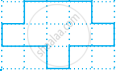
Find the area of the following figure by counting squares: