Advertisements
Advertisements
Question
In Q. No 1, if AD = 6 cm, CF = 10 cm, and AE = 8cm, find AB.
Advertisements
Solution
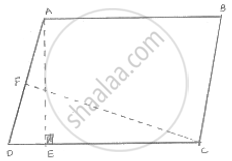
We know that,
Area of parallelogram ABCD = AD × CF ……(1)
Again area of parallelogram ABCD = DC × AE ……(2)
Compare equation (1) and equation (2)
AD × CF = DC × AE
⇒ 6 × 10 = D × B
⇒ ` D = 60 /8 = 7. 5cm`
∴ AB = DC = 7 . 5cm [ ∴ Opposite sides of a parallelogram are equal ]
APPEARS IN
RELATED QUESTIONS
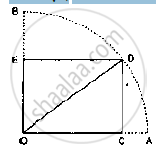
In the below fig. OCDE is a rectangle inscribed in a quadrant of a circle of radius 10 cm. If
OE = 2√5, find the area of the rectangle.
ABCD is a parallelogram. P is the mid-point of AB. BD and CP intersect at Q such that CQ: QP = 3.1. If ar (ΔPBQ) = 10cm2, find the area of parallelogram ABCD.
The mid-points of the sides of a triangle ABC along with any of the vertices as the fourth point make a parallelogram of area equal to ______.
What will happen to the area of a rectangle, if its length and breadth both are trebled?
The side of a square field is 16 m. What will be increase in its area, if each of its sides is doubled?
Karunya bought three fields.

Find the area of all three fields.
- Field (A) ____________ square metre.
- Field (B) ____________ square metre.
- Field (C) ____________ square metre.
Find all the possible dimensions (in natural numbers) of a rectangle with a perimeter 36 cm and find their areas.
Find the area of the following figure by counting squares:

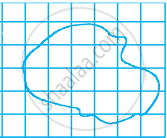
Find the area of the following figure by counting squares:
If a figure contains only 8 fully-filled squares and no partial squares, what is its area?
