Advertisements
Advertisements
Question
Let ABCD be a parallelogram of area 124 cm2. If E and F are the mid-points of sides AB and
CD respectively, then find the area of parallelogram AEFD.
Advertisements
Solution

Given,
Area of parallelogram `ABCD = 124cm^2`
Construction: draw AP ⊥ DC
Proof :
Area of parallelogram AFED = DF × AP .......(1)
And area of parallelogram EBCF = FC × AP ......(2)
And DF = FC .............(3) [ F is the midpoint of DC ]
Compare equation (1), (2) and (3)
Area of parallelogram AEFD = Area of parallelogram EBCF
∴ Area of parallelogram ABCD = `" Area of parallelogram"/"2"`
` = 124 / 2 = 62cm^2`
APPEARS IN
RELATED QUESTIONS
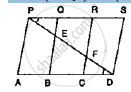
In below fig., PSDA is a parallelogram in which PQ = QR = RS and AP || BQ || CR. Prove
that ar (Δ PQE) = ar (ΔCFD).
ABCD is a trapezium with parallel sides AB =a and DC = b. If E and F are mid-points of non-parallel sides AD and BC respectively, then the ratio of areas of quadrilaterals ABFEand EFCD is
The mid-points of the sides of a triangle ABC along with any of the vertices as the fourth point make a parallelogram of area equal to ______.
Find the area of a square, whose side is: 4.1 cm.
Measure the length of the floor of your classroom in meters. Also, measure the width.
- What is the area of the floor of your classroom in square metres?
Measure the length of the floor of your classroom in meters. Also, measure the width.
- So how many children can sit in one square meter?
The King was very happy with carpenters Cheggu and Anar. They had made a very big and beautiful bed for him. So as gifts the king wanted to give some land to Cheggu, and some gold to Anar. Cheggu was happy. He took 100 meters of wire and tried to make different rectangles.
He made a 10 m × 40 m rectangle. Its area was 400 square meters. So he next made a 30 m × 20 m rectangle.
- What other rectangles can he make with 100 meters of wire? Discuss which of these rectangles will have the biggest area.
How will you decide? Discuss.
Find the area of the following figure by counting squares:

Find the area of the following figure by counting squares: