Advertisements
Advertisements
प्रश्न
Let ABCD be a parallelogram of area 124 cm2. If E and F are the mid-points of sides AB and
CD respectively, then find the area of parallelogram AEFD.
Advertisements
उत्तर

Given,
Area of parallelogram `ABCD = 124cm^2`
Construction: draw AP ⊥ DC
Proof :
Area of parallelogram AFED = DF × AP .......(1)
And area of parallelogram EBCF = FC × AP ......(2)
And DF = FC .............(3) [ F is the midpoint of DC ]
Compare equation (1), (2) and (3)
Area of parallelogram AEFD = Area of parallelogram EBCF
∴ Area of parallelogram ABCD = `" Area of parallelogram"/"2"`
` = 124 / 2 = 62cm^2`
APPEARS IN
संबंधित प्रश्न
In Q. No 1, if AD = 6 cm, CF = 10 cm, and AE = 8cm, find AB.
Diagonals AC and BD of a quadrilateral ABCD intersect each other at P. Show that:
ar(ΔAPB) × ar(ΔCPD) = ar(ΔAPD) × ar (ΔBPC)
If AD is a median of a triangle ABC, then prove that triangles ADB and ADC are equal in
area. If G is the mid-point of median AD, prove that ar (Δ BGC) = 2 ar (Δ AGC).
ABCD is a parallelogram. E is a point on BA such that BE = 2 EA and F is a point on DC
such that DF = 2 FC. Prove that AE CF is a parallelogram whose area is one third of the
area of parallelogram ABCD.
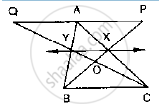
In the below fig. X and Y are the mid-points of AC and AB respectively, QP || BC and
CYQ and BXP are straight lines. Prove that ar (Δ ABP) = ar (ΔACQ).
The area of the figure formed by joining the mid-points of the adjacent sides of a rhombus with diagonals 16 cm and 12 cm is
Find the area of a rectangle whose length = 15 cm breadth = 6.4 cm
Is the area of your belt the same as the area of the postcard? Why or why not?
Measure the length of the floor of your classroom in meters. Also measure the width.
- If you want to move around easily then how many children do you think should be there in one square meter?
Find the area of the following figure by counting squares:

