Advertisements
Advertisements
प्रश्न
If ABCD is a parallelogram, then prove that
𝑎𝑟 (Δ𝐴𝐵𝐷) = 𝑎𝑟 (Δ𝐵𝐶𝐷) = 𝑎𝑟 (Δ𝐴𝐵𝐶) = 𝑎𝑟 (Δ𝐴𝐶𝐷) = `1/2` 𝑎𝑟 (||𝑔𝑚 𝐴𝐵𝐶𝐷) .
Advertisements
उत्तर
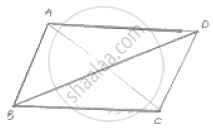
Given: ABCDis a parallelogram
To prove : area (Δ𝐴𝐵𝐷) = 𝑎𝑟 (ΔA𝐵𝐶) = are (Δ ACD)
= `1/2` 𝑎𝑟 (||𝑔𝑚 𝐴𝐵𝐶𝐷)
Proof: we know that diagonals of a parallelogram divides it into two equilaterals.
Since, AC is the diagonal.
Then, 𝑎𝑟 (Δ𝐴𝐵𝐶) = (Δ ACD) = `1/2` 𝑎𝑟 (||𝑔𝑚 𝐴𝐵𝐶𝐷)............ (1)
Since, BD is the diagonal
Then, 𝑎𝑟 (Δ𝐴𝐵𝐶) = 𝑎𝑟 (Δ𝐵𝐶𝐷) = `1/2` 𝑎𝑟 (||𝑔𝑚 𝐴𝐵𝐶𝐷)............ (2)
Compare equation (1) and (2)
∴ 𝑎𝑟 (Δ𝐴𝐵𝐶) = 𝑎𝑟 (Δ𝐴𝐶𝐷)
= 𝑎𝑟 (Δ𝐴𝐵𝐷) = 𝑎𝑟 (Δ𝐵𝐶𝐷) = `1/2` 𝑎𝑟 (||𝑔𝑚 𝐴𝐵𝐶𝐷)
APPEARS IN
संबंधित प्रश्न
ABCD is a parallelogram whose diagonals intersect at O. If P is any point on BO, prove
that: (1) ar (ΔADO) = ar (ΔCDO) (2) ar (ΔABP) = ar (ΔCBP)
ABCD is a parallelogram. P is the mid-point of AB. BD and CP intersect at Q such that CQ: QP = 3.1. If ar (ΔPBQ) = 10cm2, find the area of parallelogram ABCD.
The diagonal of a rectangular board is 1 m and its length is 96 cm. Find the area of the board.
The length and breadth of a rectangular piece of land are in the ratio 5 : 3. If the total cost of fencing it at the rate of ₹24 per meter is ₹9600, find its :
(i) length and breadth
(ii) area
(iii) cost of levelling at the rate of ₹60 per m2.
Which has the smaller area - two five-rupee notes together or a hundred rupee notes?
The King was very happy with carpenters Cheggu and Anar. They had made a very big and beautiful bed for him. So as gifts the king wanted to give some land to Cheggu, and some gold to Anar. Cheggu was happy. He took 100 meters of wire and tried to make different rectangles.
He made a 10 m × 40 m rectangle. Its area was 400 square meters. So he next made a 30 m × 20 m rectangle.
- What is its area? Is it more than the first rectangle?
Karunya bought three fields.

Find the area of all three fields.
- Field (A) ____________ square metre.
- Field (B) ____________ square metre.
- Field (C) ____________ square metre.
How will you decide? Discuss.
Find the area of the following figure by counting squares:

Find the area of the following figure by counting squares: