Advertisements
Advertisements
प्रश्न
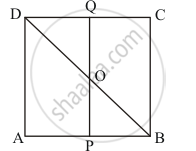
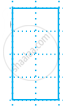
In square ABCD, P and Q are mid-point of AB and CD respectively. If AB = 8cm and PQand BD intersect at O, then find area of ΔOPB.
Advertisements
उत्तर
Given: Here from the given question we get
(1) ABCD is a square,
(2) P is the midpoint of AB
(3) Q is the midpoint of CD
(4) PQ and BD intersect at O.
(5) AB = 8cm
To find : Area of ΔOPB
Calculation: Since P is the midpoint of AB,
`BP = 1/2 (AB) `
= 1/2 (8)`
= 4 cm
BP = 4cm ……(1)
Area of triangle = `1/2 `× base × height
Area of ΔOPB = `1/2` × BP × PO (from 1)
` = 1/2 × 4 × (PO = 1/2 AD , APQD ` is a rectangle)
`= 1/2 × 16 `
Area of ΔOPB = 8 cm2
Hence we get the Area of ΔOBP = 8 cm2
APPEARS IN
संबंधित प्रश्न
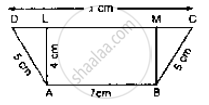
In the below fig. ABCD is a trapezium in which AB = 7 cm, AD = BC = 5 cm, DC = x cm,
and distance between AB and DC is 4cm. Find the value of x and area of trapezium ABCD.
A point D is taken on the side BC of a ΔABC such that BD = 2DC. Prove that ar(Δ ABD) =
2ar (ΔADC).
The area of the figure formed by joining the mid-points of the adjacent sides of a rhombus with diagonals 16 cm and 12 cm is
The mid-points of the sides of a triangle ABC along with any of the vertices as the fourth point make a parallelogram of area equal to ______.
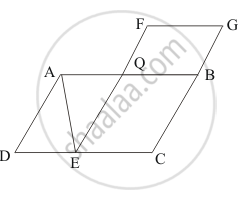
In the given figure, ABCD and FECG are parallelograms equal in area. If ar (ΔAQE) = 12 cm2, then ar (||gm FGBQ) =
Find the area of a rectangle whose length = 8.5 m breadth = 5 m.
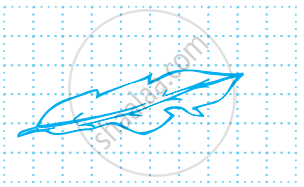
By counting squares, estimate the area of the figure.
An engineer who plans to build a compound wall on all sides of a house must find the area of the compound.
Find the area of the following figure by counting squares:
If a figure contains only 8 fully-filled squares and no partial squares, what is its area?
