Advertisements
Advertisements
प्रश्न
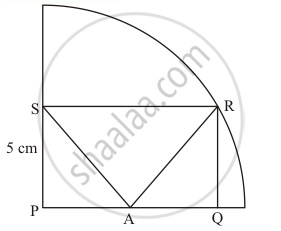
PQRS is a rectangle inscribed in a quadrant of a circle of radius 13 cm. A is any point on PQ. If PS = 5 cm, then find ar (ΔRAS)
Advertisements
उत्तर
Given: Here from the given figure we get
(1) PQRS is a rectangle inscribed in a quadrant of a circle with radius 10cm,
(2) PS = 5cm
(3) PR = 13cm(radius of the quadrant)
To find: Area of ΔRAS.
Calculation: In right ΔPSR, (Using Pythagoras Theorem)
`PR^2 = PS^2 + SR^2`
`13^2 = 5^2 + SR^2 `
`SR^2 = 13^2 - 5^2`
`SR^2 = 169-25`
`SR^2 = 144`
`SR = 12` cm
Area of Δ = `1/2 `base × height
Area of ΔRAS = `1/2 ` × base × height
`= 1/2 ` × RS × SP
`= 1/2 × 12 × 5`
`=1/2 × 60`
Area of ΔRAS = 30 cm2
Hence we get the Area of ΔRAS = 30 cm2
APPEARS IN
संबंधित प्रश्न
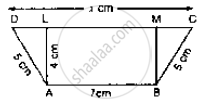
In the below fig. ABCD is a trapezium in which AB = 7 cm, AD = BC = 5 cm, DC = x cm,
and distance between AB and DC is 4cm. Find the value of x and area of trapezium ABCD.
ABCD is a parallelogram whose diagonals AC and BD intersect at O. A line through O
intersects AB at P and DC at Q. Prove that ar (Δ POA) = ar (Δ QOC).
In the given figure, find the area of ΔGEF.
ABCD is a parallelogram. P is the mid-point of AB. BD and CP intersect at Q such that CQ: QP = 3.1. If ar (ΔPBQ) = 10cm2, find the area of parallelogram ABCD.
A triangle and a parallelogram are on the same base and between the same parallels. The ratio of the areas of triangle and parallelogram is
The table given below contains some measures of the rectangle. Find the unknown values.
| Length | Breadth | Perimeter | Area |
| 13 cm | ? | 54 cm | ? |
Look at a 10 rupee note. Is its area more than hundred square cm?
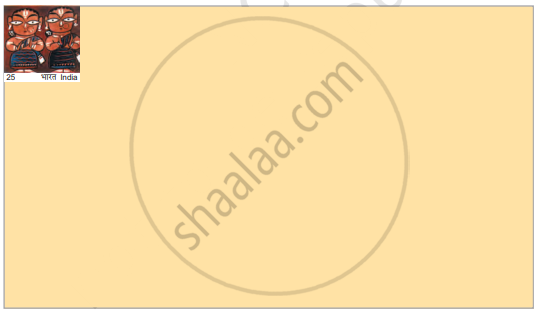
This stamp has an area of 4 square cm. Guess how many such stamps will cover this big rectangle.
A magazine charges Rs 300 per 10 sq cm area for advertising. A company decided to order a half page advertisment. If each page of the magazine is 15 cm × 24 cm, what amount will the company has to pay for it?
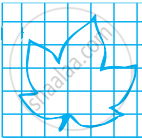
Find the area of the following figure by counting squares: