Advertisements
Advertisements
प्रश्न
ABCD is a parallelogram. P is the mid-point of AB. BD and CP intersect at Q such that CQ: QP = 3.1. If ar (ΔPBQ) = 10cm2, find the area of parallelogram ABCD.
Advertisements
उत्तर
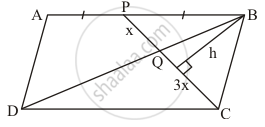
Proof:
Let, CQ = 3x & PQ = x
ar (ΔPBQ) = 10cm2 ...(1)
We know that, Area of Δ = ½ × Base × Height
ar (∆PBQ) = ½ × PQ × BQ
10 = ½ × x × h
[Let BQ = h ]
10 × 2 = xh
xh = 20 ...(2)
ar (∆BQC) = ½ × QC × BQ
ar (∆BQC) = ½ × 3(x × h)
ar (∆BQC) = ½ × 3 × 20
[From eq 2]
ar (∆BQC) = 3 × 10
ar (∆BQC) = 30 cm² ...(3)
Now,
ar (∆PCB) = ar (∆PBQ) + ar (∆BQC)
ar (∆PCB) = 10 + 30
[From eq 1 & 3]
ar (∆PCB) = 40 cm²
½ × PB × BC = 40 cm²
PB × BC = (40 × 2) cm²
PB × BC = 80 cm² ...(4)
Now, area of parallelogram = Base × Height
ar (|| gm ABCD) = AB × BC
ar (|| gm ABCD) = 2 PB × BC
[AB = 2 BP , P is the mid point of AB]
Area (ABCD) = 2 × 80
[From eq 4]
ar (ABCD) = 160 cm²
Hence, the area of parallelogram ABCD is 160 cm².
APPEARS IN
संबंधित प्रश्न
D is the mid-point of side BC of ΔABC and E is the mid-point of BD. if O is the mid-point
of AE, prove that ar (ΔBOE) = `1/8` ar (Δ ABC).
Medians of ΔABC intersect at G. If ar (ΔABC) = 27 cm2, then ar (ΔBGC) =
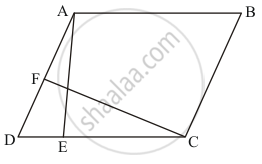
In the given figure, ABCD is a parallelogram. If AB = 12 cm, AE = 7.5 cm, CF = 15 cm, then AD =
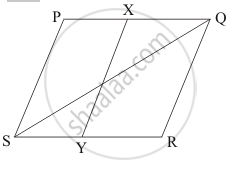
In the given figure, PQRS is a parallelogram. If X and Y are mid-points of PQ and SRrespectively and diagonal Q is joined. The ratio ar (||gm XQRY) : ar (ΔQSR) =
Find the area of a rectangle whose length = 3.6 m breadth = 90 cm
Find the area and perimeter of the following parallelograms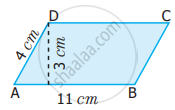
Look at a 10 rupee note. Is its area more than hundred square cm?
Altogether how many squares can be arranged on it?
Karunya bought three fields.

Find the area of all three fields.
- Field (A) ____________ square metre.
- Field (B) ____________ square metre.
- Field (C) ____________ square metre.
Find all the possible dimensions (in natural numbers) of a rectangle with a perimeter 36 cm and find their areas.
