Advertisements
Advertisements
प्रश्न
The area of the figure formed by joining the mid-points of the adjacent sides of a rhombus with diagonals 16 cm and 12 cm is
विकल्प
28 cm2
48 cm2
96 cm2
24 cm2
Advertisements
उत्तर
Given: Rhombus with diagonals measuring 16cm and 12 cm.
To find: Area of the figure formed by lines joining the midpoints of the adjacent sides.
Calculation: We know that, ‘Area of a rhombus is half the product of their diagonals’.

H and F are the midpoints of AD and BC respectively.
`AH = 1/2 AD `
`BE = 1/2 BC`
Now ABCD is a parallelogram which means
`AD = BC `
`1/2AD = 1/2BC`
AH = BF ……..(1)
Also , AD || BC
AH || BF ……(2)
From 1 and 2 we get that ABFH is a parallelogram.
Since Parallelogram FHAB and ΔFHE are on the base FH and between the same parallels HF and AB.
∴` ar (Δ FHE ) = 1/2 ar ( "||"^(gm) FHAB )` ……(3)
Similarly ,
`ar (ΔFHG) = 1/2ar ("||"^(gm) FHDC)` ……(4)
Adding 3 and 4 we get,
`ar (Δ FHE ) + ar (ΔFHG) = 1/2 ar ("||"^(gm) FHAB)+1/2ar("||"^(gm)FHDC)`
`ar (EFGH) = 1/2 (ar("||"^(gm) FHAB ) + ar ("||"^(gm) FHDC))`
`ar (EFGH) = 1/2 (ar("||"^(gm) ABCD))`
`ar (EFGH) = 1/2 (1/2 (16xx12))`
`ar (EFGH) = 1/4 (16 xx 12)`
`ar (EFGH) = 48 cm^2`
APPEARS IN
संबंधित प्रश्न
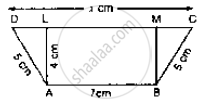
In the below fig. ABCD is a trapezium in which AB = 7 cm, AD = BC = 5 cm, DC = x cm,
and distance between AB and DC is 4cm. Find the value of x and area of trapezium ABCD.
D is the mid-point of side BC of ΔABC and E is the mid-point of BD. if O is the mid-point
of AE, prove that ar (ΔBOE) = `1/8` ar (Δ ABC).
ABCD is a parallelogram. P is any point on CD. If ar (ΔDPA) = 15 cm2 and ar (ΔAPC) = 20 cm2, then ar (ΔAPB) =
Diagonal AC and BD of trapezium ABCD, in which AB || DC, intersect each other at O. The triangle which is equal in area of ΔAOD is
The mid-points of the sides of a triangle ABC along with any of the vertices as the fourth point make a parallelogram of area equal to ______.
Each side of a square is 7 m. If its each side be increased by 3 m, what will be the increase in its area.
Who had the bigger piece? How much bigger?
Each line gives a story. You have to choose the question which makes the best story problem. The first one is already marked.
- 352 children from a school went on a camping trip. Each tent had a group of 4 children.
a) How many children did each tent have? b) How many tents do they need? c) How many children in all are in the school?
Find the area of the following figure by counting squares:

Find the area of the following figure by counting squares: