Advertisements
Advertisements
प्रश्न
Each side of a square is 7 m. If its each side be increased by 3 m, what will be the increase in its area.
Advertisements
उत्तर
Each side of square = 7 m
∴ Area of square = (side)²= (7m)²
= 7m x 7m = 49m²
∵ Side increased by 3 m
∴ Total length of side will be = 3 m + 7 m = 10m
∴ Area of square = (10 m)²= 10m x 10 m = 100 m²
∴ Increase in area = 100 m² – 49 m² = 51 m²
APPEARS IN
संबंधित प्रश्न
Diagonals AC and BD of a quadrilateral ABCD intersect each other at P. Show that:
ar(ΔAPB) × ar(ΔCPD) = ar(ΔAPD) × ar (ΔBPC)
ABCD is a parallelogram. P is the mid-point of AB. BD and CP intersect at Q such that CQ: QP = 3.1. If ar (ΔPBQ) = 10cm2, find the area of parallelogram ABCD.
Two parallelograms are on the same base and between the same parallels. The ratio of their areas is
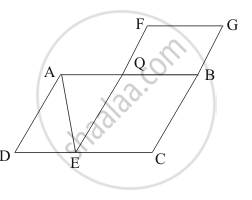
In the given figure, ABCD and FECG are parallelograms equal in area. If ar (ΔAQE) = 12 cm2, then ar (||gm FGBQ) =
Find the area of a square, whose side is: 4.5 cm.
Length of a rectangle is 30 m and its breadth is 20 m. Find the increase in its area if its length is increased by 10 m and its breadth is doubled.
The side of a square field is 16 m. What will be increase in its area, if each of its sides is increased by 4 m?
The table given below contains some measures of the rectangle. Find the unknown values.
| Length | Breadth | Perimeter | Area |
| ? | 15 cm | 60 cm | ? |
Each line gives a story. You have to choose the question which makes the best story problem. The first one is already marked.
- 352 children from a school went on a camping trip. Each tent had a group of 4 children.
a) How many children did each tent have? b) How many tents do they need? c) How many children in all are in the school?
Area of a rectangle with length 5 cm and breadth 3 cm is ______.
