Advertisements
Advertisements
प्रश्न
Each line gives a story. You have to choose the question which makes the best story problem. The first one is already marked.
- The cost of one book is Rs 47. Sonu buys 23 books.
a) How much money does she have? b) How much money does she pay for the books? c) What is the cost of 47 books?
Advertisements
उत्तर
| a) | How much money does she have? | |
| b) | How much money does she pay for the books? | ✓ |
| c) | What is the cost of 47 books? |
APPEARS IN
संबंधित प्रश्न
If ABCD is a parallelogram, then prove that
𝑎𝑟 (Δ𝐴𝐵𝐷) = 𝑎𝑟 (Δ𝐵𝐶𝐷) = 𝑎𝑟 (Δ𝐴𝐵𝐶) = 𝑎𝑟 (Δ𝐴𝐶𝐷) = `1/2` 𝑎𝑟 (||𝑔𝑚 𝐴𝐵𝐶𝐷) .
Diagonals AC and BD of a quadrilateral ABCD intersect each other at P. Show that:
ar(ΔAPB) × ar(ΔCPD) = ar(ΔAPD) × ar (ΔBPC)
If P is any point in the interior of a parallelogram ABCD, then prove that area of the
triangle APB is less than half the area of parallelogram.
If AD is a median of a triangle ABC, then prove that triangles ADB and ADC are equal in
area. If G is the mid-point of median AD, prove that ar (Δ BGC) = 2 ar (Δ AGC).
A point D is taken on the side BC of a ΔABC such that BD = 2DC. Prove that ar(Δ ABD) =
2ar (ΔADC).
ABCD is a parallelogram in which BC is produced to E such that CE = BC. AE intersects
CD at F.
(i) Prove that ar (ΔADF) = ar (ΔECF)
(ii) If the area of ΔDFB = 3 cm2, find the area of ||gm ABCD.
In the given figure, find the area of ΔGEF.
ABC is a triangle in which D is the mid-point of BC. E and F are mid-points of DC and AErespectively. IF area of ΔABC is 16 cm2, find the area of ΔDEF.
PQRS is a trapezium having PS and QR as parallel sides. A is any point on PQ and B is a point on SR such that AB || QR. If area of ΔPBQ is 17cm2, find the area of ΔASR.
P is any point on base BC of ΔABC and D is the mid-point of BC. DE is drawn parallel toPA to meet AC at E. If ar (ΔABC) = 12 cm2, then find area of ΔEPC.
Let ABC be a triangle of area 24 sq. units and PQR be the triangle formed by the mid-points of the sides of Δ ABC. Then the area of ΔPQR is
Medians of ΔABC intersect at G. If ar (ΔABC) = 27 cm2, then ar (ΔBGC) =
In a ΔABC if D and E are mid-points of BC and AD respectively such that ar (ΔAEC) = 4cm2, then ar (ΔBEC) =
Find the area of a rectangle whose length and breadth are 25 m and 16 cm.
Each side of a square is 7 m. If its each side be increased by 3 m, what will be the increase in its area.
What will happen to the area of a rectangle, if its length and breadth both are trebled?
The side of a square field is 16 m. What will be increase in its area, if each of its sides is doubled?
Find the area and perimeter of the following parallelograms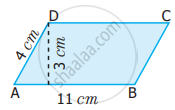
The table given below contains some measures of the rectangle. Find the unknown values.
| Length | Breadth | Perimeter | Area |
| ? | 15 cm | 60 cm | ? |
Which has the bigger area - one of your footprints or the page of this book?
Altogether how many squares can be arranged on it?
Who had the bigger piece? How much bigger?
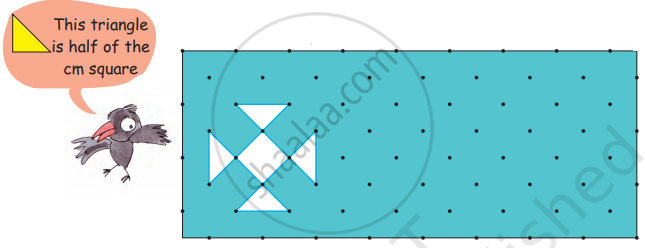
How many tiles like the triangle given here will fit in the white design?
Area of design = ________ square cm
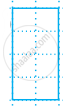
Find all the possible dimensions (in natural numbers) of a rectangle with a perimeter 36 cm and find their areas.
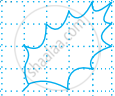
Find the area of the following figure by counting squares:

Find the area of the following figure by counting squares:
Find the area of the following figure by counting squares:

Find the area of the following figure by counting squares:
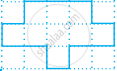
Find the area of the following figure by counting squares: