Advertisements
Advertisements
प्रश्न
Diagonals AC and BD of a quadrilateral ABCD intersect each other at P. Show that:
ar(ΔAPB) × ar(ΔCPD) = ar(ΔAPD) × ar (ΔBPC)
Advertisements
उत्तर

Construction: Draw BQ ⊥ AC and DR ⊥ AC
Proof:
L.H.S
= ar (Δ APB ) × ar (ΔCP)
= `1/2[ ( AP xx BQ )] xx (1/2 xx PC xx DR)`
=`( 1/2 xx PC xx BQ )xx (1/2 xx AP xx DR)`
= ar (Δ BPC ) × ar (APR)
= RHS
∴ LHS = RHS
Hence proved.
APPEARS IN
संबंधित प्रश्न
In Q. No 1, if AD = 6 cm, CF = 10 cm, and AE = 8cm, find AB.
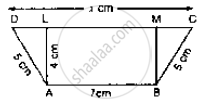
In the below fig. ABCD is a trapezium in which AB = 7 cm, AD = BC = 5 cm, DC = x cm,
and distance between AB and DC is 4cm. Find the value of x and area of trapezium ABCD.
What will happen to the area of a rectangle, if its length and breadth both are trebled?
Find the area and perimeter of the following parallelograms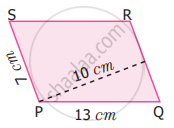
Parth and Gini bought aam papad (dried mango slice) from a shop. Their pieces looked like these. Both could not make out whose piece was bigger.
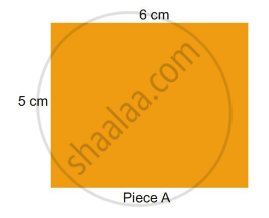

- Suggest some ways to find out whose piece is bigger. Discuss
What is the area of the rectangle? ________ square cm
A magazine charges Rs 300 per 10 sq cm area for advertising. A company decided to order a half page advertisment. If each page of the magazine is 15 cm × 24 cm, what amount will the company has to pay for it?
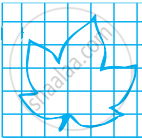
Find the area of the following figure by counting squares:

Find the area of the following figure by counting squares:

Find the area of the following figure by counting squares: