Advertisements
Advertisements
प्रश्न
Diagonals AC and BD of a quadrilateral ABCD intersect each other at P. Show that:
ar(ΔAPB) × ar(ΔCPD) = ar(ΔAPD) × ar (ΔBPC)
Advertisements
उत्तर

Construction: Draw BQ ⊥ AC and DR ⊥ AC
Proof:
L.H.S
= ar (Δ APB ) × ar (ΔCP)
= `1/2[ ( AP xx BQ )] xx (1/2 xx PC xx DR)`
=`( 1/2 xx PC xx BQ )xx (1/2 xx AP xx DR)`
= ar (Δ BPC ) × ar (APR)
= RHS
∴ LHS = RHS
Hence proved.
APPEARS IN
संबंधित प्रश्न
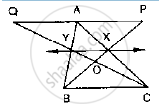
In the below fig. X and Y are the mid-points of AC and AB respectively, QP || BC and
CYQ and BXP are straight lines. Prove that ar (Δ ABP) = ar (ΔACQ).
Medians of ΔABC intersect at G. If ar (ΔABC) = 27 cm2, then ar (ΔBGC) =
ABCD is a trapezium with parallel sides AB =a and DC = b. If E and F are mid-points of non-parallel sides AD and BC respectively, then the ratio of areas of quadrilaterals ABFEand EFCD is
Find the area of a square, whose side is: 7.2 cm.
Find the area of a square, whose side is: 4.1 cm.
Find the area and perimeter of the following parallelograms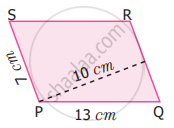
Is the area of the blue shape more than the area of the yellow shape? Why?


Measure the length of the floor of your classroom in meters. Also, measure the width.
- So how many children can sit in one square meter?
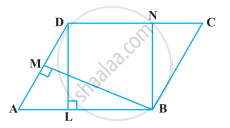
In the following figure, the area of parallelogram ABCD is ______.
How will you decide? Discuss.
