Advertisements
Advertisements
प्रश्न
Find the area and perimeter of the following parallelograms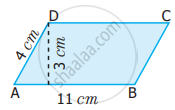
Advertisements
उत्तर
Given: base b = 11 cm
height h = 3 cm
Area of the parallelogram = b × h sq.units
= 11 × 3 cm2
= 33 cm2
Also perimeter of a parallelogram = Sum of 4 sides
= 11 cm + 4 cm + 11 cm + 4 cm
= 30 cm
Area = 33 cm2, Perimeter = 30 cm.
APPEARS IN
संबंधित प्रश्न
If AD is a median of a triangle ABC, then prove that triangles ADB and ADC are equal in
area. If G is the mid-point of median AD, prove that ar (Δ BGC) = 2 ar (Δ AGC).
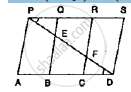
In below fig., PSDA is a parallelogram in which PQ = QR = RS and AP || BQ || CR. Prove
that ar (Δ PQE) = ar (ΔCFD).
Let ABC be a triangle of area 24 sq. units and PQR be the triangle formed by the mid-points of the sides of Δ ABC. Then the area of ΔPQR is
ABCD is a parallelogram. P is any point on CD. If ar (ΔDPA) = 15 cm2 and ar (ΔAPC) = 20 cm2, then ar (ΔAPB) =
If AD is median of ΔABC and P is a point on AC such that
ar (ΔADP) : ar (ΔABD) = 2 : 3, then ar (Δ PDC) : ar (Δ ABC)
ABCD is a rectangle with O as any point in its interior. If ar (ΔAOD) = 3 cm2 and ar (ΔABOC) = 6 cm2, then area of rectangle ABCD is
Each line gives a story. You have to choose the question which makes the best story problem. The first one is already marked.
- The cost of one book is Rs 47. Sonu buys 23 books.
a) How much money does she have? b) How much money does she pay for the books? c) What is the cost of 47 books?
Find the area of the following figure by counting squares:

Find the area of the following figure by counting squares:

Which statement correctly describes how area is determined?
