Advertisements
Advertisements
प्रश्न
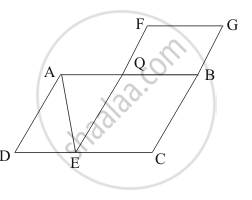
In the given figure, ABCD and FECG are parallelograms equal in area. If ar (ΔAQE) = 12 cm2, then ar (||gm FGBQ) =
विकल्प
12 cm2
20 cm2
24 cm2
36 cm2
Advertisements
उत्तर
Given: (1) Area of parallelogram ABCD is equal to Area of parallelogram FECG.
(2) If Area of ΔAQE is 12cm.
To find: Area of parallelogram FGBQ
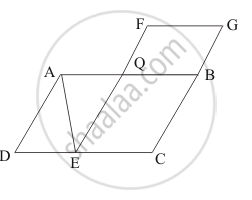
Calculation: We know that diagonal of a parallelogram divides the parallelogram into two triangles of equal area.
It is given that,
`ar ("||"^(gm)ABCD) = ar ("||"^(gm) FECG)`
`⇒ ar (ΔADE) + ar (ΔAQE) + ar ( "||"^(gm) QECB ) = ar ("||"^(gm) QECB) + ar ("||"^(gm) FQBG)`
`⇒ ar (ΔADE) + ar (ΔAQE) = ar "||"^(gm) FQBG`
`⇒ 2ar (ΔAQE) = ar ( "||"^(gm) FQBG)`
`⇒ar ( "||"^(gm) FQBG) = 2ar (ΔAQE) `
`⇒ar ( "||"^(gm) FQBG) = 2 xx 12`
`⇒ar ( "||"^(gm) FQBG) = 24 cm^2`
APPEARS IN
संबंधित प्रश्न
If AD is a median of a triangle ABC, then prove that triangles ADB and ADC are equal in
area. If G is the mid-point of median AD, prove that ar (Δ BGC) = 2 ar (Δ AGC).
ABCD is a parallelogram whose diagonals AC and BD intersect at O. A line through O
intersects AB at P and DC at Q. Prove that ar (Δ POA) = ar (Δ QOC).
D is the mid-point of side BC of ΔABC and E is the mid-point of BD. if O is the mid-point
of AE, prove that ar (ΔBOE) = `1/8` ar (Δ ABC).
PQRS is a trapezium having PS and QR as parallel sides. A is any point on PQ and B is a point on SR such that AB || QR. If area of ΔPBQ is 17cm2, find the area of ΔASR.
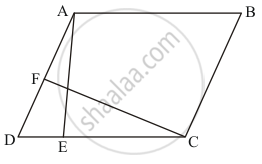
In the given figure, ABCD is a parallelogram. If AB = 12 cm, AE = 7.5 cm, CF = 15 cm, then AD =
Each side of a square is 7 m. If its each side be increased by 3 m, what will be the increase in its area.
Which has the smaller area - two five-rupee notes together or a hundred rupee notes?
Look at the table. If you were to write the area of each of these which column would you choose? Make a (✓).
| Square cm |
Square meter |
Square km |
|
| Handkerchief | ✓ | ||
| Sari | |||
| Page of your book | |||
| School land | |||
| Total land of a city | |||
| Door of your classroom | |||
| Chair seat | |||
| Blackboard | |||
| Indian flag | |||
| Land over which a river flows |
Find the area of the following figure by counting squares:

Find the area of the following figure by counting squares:

