Advertisements
Advertisements
प्रश्न
The mid-points of the sides of a triangle ABC along with any of the vertices as the fourth point make a parallelogram of area equal to ______.
विकल्प
`1/2` ar (ABC)
- `1/3` ar (ABC)
- `1/4` ar (ABC)
- ar (ABC)
Advertisements
उत्तर
The mid-points of the sides of a triangle ABC along with any of the vertices as the fourth point make a parallelogram of area equal to `underlinebb(1/2 ar (ABC))`.
Explanation:
Given: ABCD is a triangle.
Mid points of the sides of ΔABC with any of the vertices forms a parallelogram.
To find: Area of the parallelogram
Calculation: We know that, Area of a parallelogram = base × height
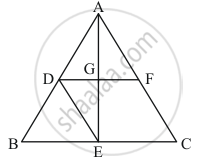
Hence area of || gm DECF = EC × EG
area of || gm DECF = EC × EG
area of || gm DECF = `1/2 BC xx 1/2 AE` ...(E is the midpoint of BC)
area of || gm DECF = `1/2(1/2BC xx AE)`
area of || gm DECF = `1/2(ar ( ΔABC) `
संबंधित प्रश्न
Let ABCD be a parallelogram of area 124 cm2. If E and F are the mid-points of sides AB and
CD respectively, then find the area of parallelogram AEFD.
If P is any point in the interior of a parallelogram ABCD, then prove that area of the
triangle APB is less than half the area of parallelogram.
D is the mid-point of side BC of ΔABC and E is the mid-point of BD. if O is the mid-point
of AE, prove that ar (ΔBOE) = `1/8` ar (Δ ABC).
P is any point on base BC of ΔABC and D is the mid-point of BC. DE is drawn parallel toPA to meet AC at E. If ar (ΔABC) = 12 cm2, then find area of ΔEPC.
Find the area of a square, whose side is: 4.1 cm.
Find the area and perimeter of the following parallelograms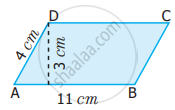
Look at the table. If you were to write the area of each of these which column would you choose? Make a (✓).
| Square cm |
Square meter |
Square km |
|
| Handkerchief | ✓ | ||
| Sari | |||
| Page of your book | |||
| School land | |||
| Total land of a city | |||
| Door of your classroom | |||
| Chair seat | |||
| Blackboard | |||
| Indian flag | |||
| Land over which a river flows |
Find the area of the following figure by counting squares:
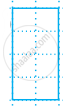
Find the area of the following figure by counting squares:

Which unit is used to express area?
