Advertisements
Advertisements
प्रश्न
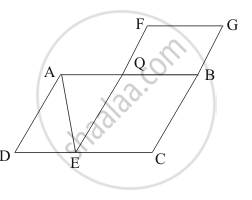
In the given figure, ABCD and FECG are parallelograms equal in area. If ar (ΔAQE) = 12 cm2, then ar (||gm FGBQ) =
पर्याय
12 cm2
20 cm2
24 cm2
36 cm2
Advertisements
उत्तर
Given: (1) Area of parallelogram ABCD is equal to Area of parallelogram FECG.
(2) If Area of ΔAQE is 12cm.
To find: Area of parallelogram FGBQ
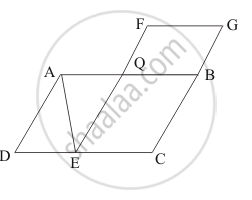
Calculation: We know that diagonal of a parallelogram divides the parallelogram into two triangles of equal area.
It is given that,
`ar ("||"^(gm)ABCD) = ar ("||"^(gm) FECG)`
`⇒ ar (ΔADE) + ar (ΔAQE) + ar ( "||"^(gm) QECB ) = ar ("||"^(gm) QECB) + ar ("||"^(gm) FQBG)`
`⇒ ar (ΔADE) + ar (ΔAQE) = ar "||"^(gm) FQBG`
`⇒ 2ar (ΔAQE) = ar ( "||"^(gm) FQBG)`
`⇒ar ( "||"^(gm) FQBG) = 2ar (ΔAQE) `
`⇒ar ( "||"^(gm) FQBG) = 2 xx 12`
`⇒ar ( "||"^(gm) FQBG) = 24 cm^2`
APPEARS IN
संबंधित प्रश्न
If AD is a median of a triangle ABC, then prove that triangles ADB and ADC are equal in
area. If G is the mid-point of median AD, prove that ar (Δ BGC) = 2 ar (Δ AGC).
ABCD is a rectangle with O as any point in its interior. If ar (ΔAOD) = 3 cm2 and ar (ΔABOC) = 6 cm2, then area of rectangle ABCD is
The length and breadth of a rectangular piece of land are in the ratio 5 : 3. If the total cost of fencing it at the rate of ₹24 per meter is ₹9600, find its :
(i) length and breadth
(ii) area
(iii) cost of levelling at the rate of ₹60 per m2.
Which has the bigger area - one of your footprints or the page of this book?
This stamp has an area of 4 square cm. Guess how many such stamps will cover this big rectangle.
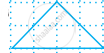
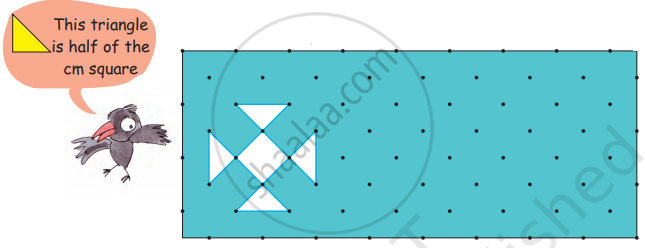
How many tiles like the triangle given here will fit in the white design?
Area of design = ________ square cm
Nasreena is a farmer who wants to divide her land equally among her three children — Chumki, Jhumri, and Imran. She wants to divide the land so that each piece of land has one tree. Her land looks like this.

- Can you divide the land equally? Show how you will divide it. Remember each person has to get a tree. Colour each person’s piece of land differently.
The King was very happy with carpenters Cheggu and Anar. They had made a very big and beautiful bed for him. So as gifts the king wanted to give some land to Cheggu, and some gold to Anar. Cheggu was happy. He took 100 meters of wire and tried to make different rectangles.
He made a 10 m × 40 m rectangle. Its area was 400 square meters. So he next made a 30 m × 20 m rectangle.
- What is its area? Is it more than the first rectangle?
Each line gives a story. You have to choose the question which makes the best story problem. The first one is already marked.
- 352 children from a school went on a camping trip. Each tent had a group of 4 children.
a) How many children did each tent have? b) How many tents do they need? c) How many children in all are in the school?
Find the area of the following figure by counting squares: