Advertisements
Advertisements
प्रश्न
A floor is 40 m long and 15 m broad. It is covered with tiles, each measuring 60 cm by 50 cm. Find the number of tiles required to cover the floor.
Advertisements
उत्तर
Length of floor (l) = 40 m
breadth of floor (b) = 15 m
∴ Area of floor = l × b = 40 × 15 = 600 m2
Length of one tile = 60 cm =`6/10` m
and breadth = 50 cm = `5/10` m
∴ Area of one tile = `6/10xx5/10`
= `30/100=3/10"m"^2`
∴ Number of tiles =`"Total area of floor"/"Area of one tile"`
= `600/(3/10)=(600xx10)/3=2000`
APPEARS IN
संबंधित प्रश्न
If AD is a median of a triangle ABC, then prove that triangles ADB and ADC are equal in
area. If G is the mid-point of median AD, prove that ar (Δ BGC) = 2 ar (Δ AGC).
PQRS is a trapezium having PS and QR as parallel sides. A is any point on PQ and B is a point on SR such that AB || QR. If area of ΔPBQ is 17cm2, find the area of ΔASR.
ABCD is a parallelogram. P is any point on CD. If ar (ΔDPA) = 15 cm2 and ar (ΔAPC) = 20 cm2, then ar (ΔAPB) =
Find the area of a square, whose side is: 4.1 cm.
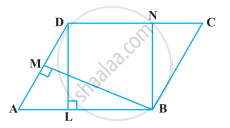
In the following figure, the area of parallelogram ABCD is ______.
Area of a rectangle with length 5 cm and breadth 3 cm is ______.
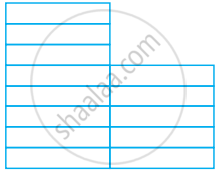
The region given in the following figure is measured by taking  as a unit. What is the area of the region?
Find all the possible dimensions (in natural numbers) of a rectangle with a perimeter 36 cm and find their areas.
Find the area of the following figure by counting squares:

Which statement correctly describes how area is determined?
