Advertisements
Advertisements
प्रश्न
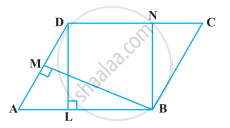
In the following figure, the area of parallelogram ABCD is ______.
पर्याय
AB × BM
BC × BN
DC × DL
AD × DL
Advertisements
उत्तर
In the following figure, the area of parallelogram ABCD is DC × DL.
Explanation:
We know that, area of parallelogram is the product of its any side and the corresponding altitude (or height).
Here, when AB is base, then height is DL.
Area of parallelogram = AB × DL and when AD is base, then height is BM.
Area of parallelogram = AD × BM When DC is base, then height is DL.
Area of parallelogram = DC × DL and when BC is base, then height is not given.
संबंधित प्रश्न
ABCD is a parallelogram in which BC is produced to E such that CE = BC. AE intersects
CD at F.
(i) Prove that ar (ΔADF) = ar (ΔECF)
(ii) If the area of ΔDFB = 3 cm2, find the area of ||gm ABCD.
Medians of ΔABC intersect at G. If ar (ΔABC) = 27 cm2, then ar (ΔBGC) =
In a ΔABC if D and E are mid-points of BC and AD respectively such that ar (ΔAEC) = 4cm2, then ar (ΔBEC) =
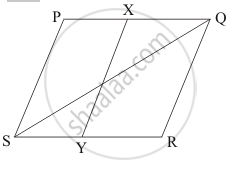
In the given figure, PQRS is a parallelogram. If X and Y are mid-points of PQ and SRrespectively and diagonal Q is joined. The ratio ar (||gm XQRY) : ar (ΔQSR) =
Find the area of a rectangle whose length = 8.5 m breadth = 5 m.
Length of a rectangle is 30 m and its breadth is 20 m. Find the increase in its area if its length is increased by 10 m and its breadth is doubled.
Who had the bigger piece? How much bigger?
If each square on this page is equal to 1 square meter of land, how much land will each of her children get? ________ square m
Each line gives a story. You have to choose the question which makes the best story problem. The first one is already marked.
- 352 children from a school went on a camping trip. Each tent had a group of 4 children.
a) How many children did each tent have? b) How many tents do they need? c) How many children in all are in the school?
Find the area of the following figure by counting squares: