Advertisements
Advertisements
प्रश्न
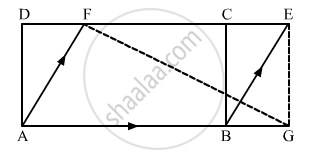
In the given figure, ABCD is a rectangle with sides AB = 10 cm and AD = 5 cm. Find the area of ΔEFG.
Advertisements
उत्तर
Given: (1) ABCD is a rectangle.
(2) AB = 10 cm
(3) AD = 5cm
To find: Area of ΔEGF.
Calculation: We know that,
Area of Rectangle = base × height
If a triangle and a parallelogram are on the same base and between the same parallels, the area of the triangle is equal to half of the parallelogram
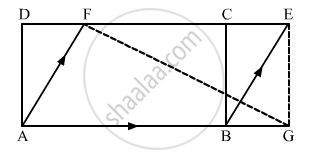
Here we can see that Rectangle ABCD and triangle GEF are between the same base and same parallels.
Hence,
Area of ΔGEF = `1/2` Area of Rectangle ABCD
`= 1/2 xx AD xx CD`
`= 1/2 xx 10 xx 5 `
= 25 cm2
Hence we get the result as Area of ΔGEF = 25 cm2
APPEARS IN
संबंधित प्रश्न
If ABCD is a parallelogram, then prove that
𝑎𝑟 (Δ𝐴𝐵𝐷) = 𝑎𝑟 (Δ𝐵𝐶𝐷) = 𝑎𝑟 (Δ𝐴𝐵𝐶) = 𝑎𝑟 (Δ𝐴𝐶𝐷) = `1/2` 𝑎𝑟 (||𝑔𝑚 𝐴𝐵𝐶𝐷) .
Two parallelograms are on the same base and between the same parallels. The ratio of their areas is
Let ABC be a triangle of area 24 sq. units and PQR be the triangle formed by the mid-points of the sides of Δ ABC. Then the area of ΔPQR is
ABCD is a rectangle with O as any point in its interior. If ar (ΔAOD) = 3 cm2 and ar (ΔABOC) = 6 cm2, then area of rectangle ABCD is
A floor is 40 m long and 15 m broad. It is covered with tiles, each measuring 60 cm by 50 cm. Find the number of tiles required to cover the floor.
Find the area of a rectangle whose length = 3.6 m breadth = 90 cm
Karunya bought three fields.

Find the area of all three fields.
- Field (A) ____________ square metre.
- Field (B) ____________ square metre.
- Field (C) ____________ square metre.
Each line gives a story. You have to choose the question which makes the best story problem. The first one is already marked.
- The cost of one book is Rs 47. Sonu buys 23 books.
a) How much money does she have? b) How much money does she pay for the books? c) What is the cost of 47 books?
Find all the possible dimensions (in natural numbers) of a rectangle with a perimeter 36 cm and find their areas.
Find the area of the following figure by counting squares:

