Advertisements
Advertisements
प्रश्न
PQRS is a rectangle inscribed in a quadrant of a circle of radius 13 cm. A is any point on PQ. If PS = 5 cm, then find ar (ΔRAS)
Advertisements
उत्तर
Given: Here from the given figure we get
(1) PQRS is a rectangle inscribed in a quadrant of a circle with radius 10cm,
(2) PS = 5cm
(3) PR = 13cm(radius of the quadrant)
To find: Area of ΔRAS.
Calculation: In right ΔPSR, (Using Pythagoras Theorem)
`PR^2 = PS^2 + SR^2`
`13^2 = 5^2 + SR^2 `
`SR^2 = 13^2 - 5^2`
`SR^2 = 169-25`
`SR^2 = 144`
`SR = 12` cm
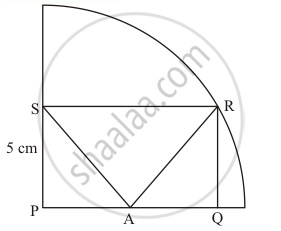
Area of Δ = `1/2 `base × height
Area of ΔRAS = `1/2 ` × base × height
`= 1/2 ` × RS × SP
`= 1/2 × 12 × 5`
`=1/2 × 60`
Area of ΔRAS = 30 cm2
Hence we get the Area of ΔRAS = 30 cm2
APPEARS IN
संबंधित प्रश्न
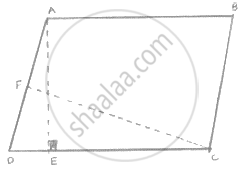
In fig below, ABCD is a parallelogram, AE ⊥ DC and CF ⊥ AD. If AB = 16 cm, AE = 8
cm and CF = 10 cm, find AD.
Let ABC be a triangle of area 24 sq. units and PQR be the triangle formed by the mid-points of the sides of Δ ABC. Then the area of ΔPQR is
Find the area of a rectangle whose length and breadth are 25 m and 16 cm.
Find the area of a rectangle whose length = 24 cm breadth =180 mm
The side of a square field is 16 m. What will be increase in its area, if each of its sides is increased by 4 m?
Find the area and perimeter of the following parallelograms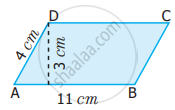
Measure the length of the floor of your classroom in meters. Also, measure the width.
- What is the area of the floor of your classroom in square metres?
The King was very happy with carpenters Cheggu and Anar. They had made a very big and beautiful bed for him. So as gifts the king wanted to give some land to Cheggu, and some gold to Anar. Cheggu was happy. He took 100 meters of wire and tried to make different rectangles.
He made a 10 m × 40 m rectangle. Its area was 400 square meters. So he next made a 30 m × 20 m rectangle.
- What other rectangles can he make with 100 meters of wire? Discuss which of these rectangles will have the biggest area.
Cheggu’s wife asked him to make a circle with the wire. She knew it had an area of 800 square meters.
- Why did Cheggu not choose a rectangle? Explain.
Find the area of the following figure by counting squares:

