Advertisements
Advertisements
Question
PQRS is a rectangle inscribed in a quadrant of a circle of radius 13 cm. A is any point on PQ. If PS = 5 cm, then find ar (ΔRAS)
Advertisements
Solution
Given: Here from the given figure we get
(1) PQRS is a rectangle inscribed in a quadrant of a circle with radius 10cm,
(2) PS = 5cm
(3) PR = 13cm(radius of the quadrant)
To find: Area of ΔRAS.
Calculation: In right ΔPSR, (Using Pythagoras Theorem)
`PR^2 = PS^2 + SR^2`
`13^2 = 5^2 + SR^2 `
`SR^2 = 13^2 - 5^2`
`SR^2 = 169-25`
`SR^2 = 144`
`SR = 12` cm
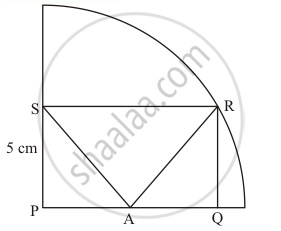
Area of Δ = `1/2 `base × height
Area of ΔRAS = `1/2 ` × base × height
`= 1/2 ` × RS × SP
`= 1/2 × 12 × 5`
`=1/2 × 60`
Area of ΔRAS = 30 cm2
Hence we get the Area of ΔRAS = 30 cm2
APPEARS IN
RELATED QUESTIONS
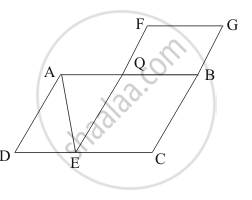
In the given figure, ABCD and FECG are parallelograms equal in area. If ar (ΔAQE) = 12 cm2, then ar (||gm FGBQ) =
Each side of a square is 7 m. If its each side be increased by 3 m, what will be the increase in its area.
The table given below contains some measures of the rectangle. Find the unknown values.
| Length | Breadth | Perimeter | Area |
| ? | 15 cm | 60 cm | ? |
Is the area of the blue shape more than the area of the yellow shape? Why?

Nasreena is a farmer who wants to divide her land equally among her three children — Chumki, Jhumri, and Imran. She wants to divide the land so that each piece of land has one tree. Her land looks like this.

- Can you divide the land equally? Show how you will divide it. Remember each person has to get a tree. Colour each person’s piece of land differently.
Measure the length of the floor of your classroom in meters. Also measure the width.
- If you want to move around easily then how many children do you think should be there in one square meter?
Area of a rectangle with length 5 cm and breadth 3 cm is ______.
The region given in the following figure is measured by taking  as a unit. What is the area of the region?
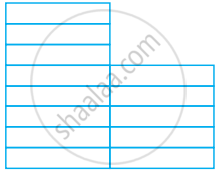
Find the area of the following figure by counting squares:

Find the area of the following figure by counting squares: