Advertisements
Advertisements
Question
The table given below contains some measures of the rectangle. Find the unknown values.
| Length | Breadth | Perimeter | Area |
| 13 cm | ? | 54 cm | ? |
Advertisements
Solution
l = 13 cm
p = 54 cm
Perimeter = 2(l + b) units
54 = 2(13 + b) cm
`54/2` = 13 + b
27 = 13 + b
b = 27 – 13
b = 14 cm
Area = l × b sq.unit
= 13 × 14 cm2
A = 182 cm2
Completing the unknown values in the table.
| Length | Breadth | Perimeter | Area |
| 13 cm | 14 cm | 54 cm | 182 cm2 |
APPEARS IN
RELATED QUESTIONS
In the given figure, find the area of ΔGEF.
In the given figure, ABCD is a rectangle with sides AB = 10 cm and AD = 5 cm. Find the area of ΔEFG.
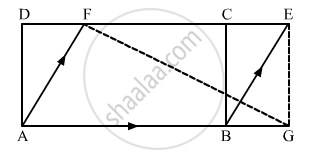
In square ABCD, P and Q are mid-point of AB and CD respectively. If AB = 8cm and PQand BD intersect at O, then find area of ΔOPB.
The figure obtained by joining the mid-points of the adjacent sides of a rectangle of sides 8 cm and 6 cm is ______.
The mid-points of the sides of a triangle ABC along with any of the vertices as the fourth point make a parallelogram of area equal to ______.
The side of a square field is 16 m. What will be increase in its area, if each of its sides is increased by 4 m?
Each line gives a story. You have to choose the question which makes the best story problem. The first one is already marked.
- A shopkeeper has 204 eggs. He puts them in egg trays. Each tray has 12 eggs.
a) How many more eggs will he need? b) How many fresh eggs does he sell? c) How many egg trays does he need?
Find the area of the following figure by counting squares:
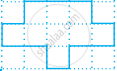
Find the area of the following figure by counting squares:
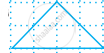
Which statement correctly describes how area is determined?
