Advertisements
Advertisements
Question
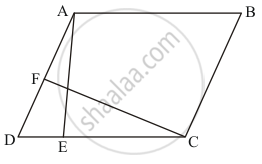
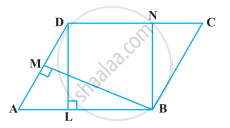
In the given figure, ABCD is a parallelogram. If AB = 12 cm, AE = 7.5 cm, CF = 15 cm, then AD =
Advertisements
Solution
Given: (1) ABCD is a parallelogram.
(2) AB = 12 cm
(3) AE = 7.5 cm
(4) CF = 15cm
To find: AD
Calculation: We know that,
Area of a parallelogram = base × height
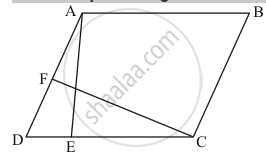
Area of a parallelogram ABCD = DC ×AE (with DC as base and AE as height) ……(1)
Area of a parallelogram ABCD = AD ×CF (with DC as base and AE as height) ……(2)
Since equation 1 and 2 both are Area of a parallelogram ABCD
`DC xx AE = AD xx CF`
`AD = (DC xx AE)/(CF)`
`AD = (AB xx AE)/(CF)` (AB = DC , opposite sides of parallelogram are eual )
`AD = (12 xx 7.5)/15`
AD = 6 cm
APPEARS IN
RELATED QUESTIONS
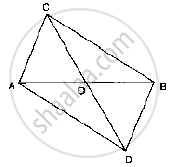
In the below Fig, ABC and ABD are two triangles on the base AB. If line segment CD is
bisected by AB at O, show that ar (Δ ABC) = ar (Δ ABD)
ABC is a triangle in which D is the mid-point of BC. E and F are mid-points of DC and AErespectively. IF area of ΔABC is 16 cm2, find the area of ΔDEF.
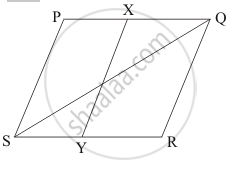
In the given figure, PQRS is a parallelogram. If X and Y are mid-points of PQ and SRrespectively and diagonal Q is joined. The ratio ar (||gm XQRY) : ar (ΔQSR) =
The diagonal of a rectangular board is 1 m and its length is 96 cm. Find the area of the board.
The table given below contains some measures of the rectangle. Find the unknown values.
| Length | Breadth | Perimeter | Area |
| ? | 15 cm | 60 cm | ? |
Which has the smaller area - two five-rupee notes together or a hundred rupee notes?
In the following figure, the area of parallelogram ABCD is ______.
Is the area of both your footprints the same?
Find the area of the following figure by counting squares:
Find the area of the following figure by counting squares: